

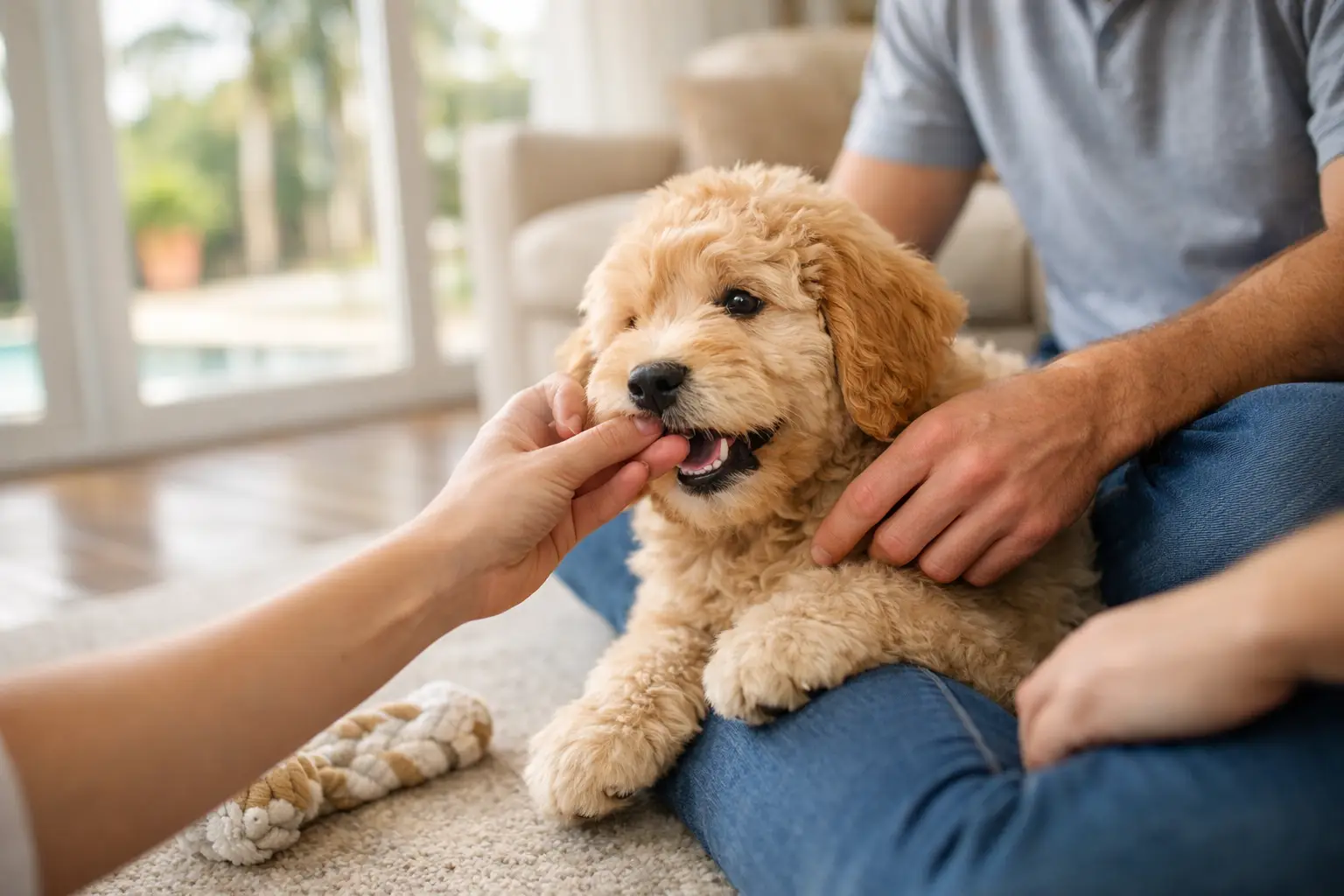
Those tiny puppy teeth can feel surprisingly sharp, especially when your puppy grabs a child’s sleeve during play or starts treating your hands like a favorite chew toy. If you are wondering how to stop puppy biting, please know that this is one of the most common questions new families ask me. It does not mean you have a bad puppy or that you are doing everything wrong. Your little one is learning about the world, and with calm, consistent guidance, this stage will pass.
At Shalom Goldendoodles, I see puppies begin learning gentle manners long before they join their forever families. Still, moving into a new home is exciting, and puppies need time to learn each family’s routines, rules, and expectations. The goal is not to punish normal puppy behavior. It is to clearly teach your puppy what to do instead.
Why Puppies Bite in the First Place
Puppies explore with their mouths much like babies explore with their hands. They mouth, nibble, and chew to investigate new things, invite play, and relieve discomfort from teething. Goldendoodles are bright, social dogs, so they may also use their mouths when they want your attention or become excited.
Biting often gets worse at certain times of day. Many families notice the evening “zoomies,” when a puppy becomes wiggly, wild, and extra mouthy. That is not usually a sign that your puppy needs more rough play. Often, it means they are overtired, overstimulated, or ready for a quiet nap.
It also helps to tell the difference between normal puppy mouthing and behavior that needs extra support. A playful puppy usually has a loose, wiggly body and can be redirected. A puppy who is stiff, growling over food or toys, guarding items, or biting hard enough to break skin should be assessed promptly by your veterinarian and a qualified force-free trainer or veterinary behavior professional.
How to Stop Puppy Biting With Consistent Responses
The fastest way to confuse a puppy is for one person to allow hand play while another person corrects it. Decide as a family that teeth do not touch skin, clothing, shoes, or hair during play. Then respond the same way each time, as calmly as possible.
End the fun the moment teeth touch skin
When your puppy bites, avoid jerking your hand away or squealing loudly. Quick movement can make you seem more like a fun chase toy, and high-pitched noises excite some puppies even more. Instead, calmly freeze for a moment and say a simple phrase such as, “Too bad,” or “All done.”
Then stand up and quietly step away for 10 to 20 seconds. This is not a scary punishment or a long isolation period. It simply teaches a very clear lesson: gentle play keeps people close, while biting makes play stop. Return calmly and give your puppy another opportunity to make a better choice.
If your puppy bites again right away, they may be too wound up to learn. Guide them to a safe, quiet space with a chew toy and an opportunity to rest. Young puppies need a great deal of sleep, often 18 to 20 hours across a full day. A rested puppy is usually a much gentler puppy.
Redirect before the bite happens
Keep an appropriate toy nearby wherever your family spends time with the puppy. If you see that playful look in your puppy’s eyes or notice them moving toward hands and pant legs, offer a toy before teeth make contact. Praise warmly when they take it.
A soft tug toy, a durable puppy-safe rubber toy, or a chilled teething toy can give your puppy an acceptable outlet. Tug can be a wonderful game when it is done thoughtfully. Keep the toy low, use gentle movement, and pause the game if your puppy catches your hand or becomes too frantic. Your puppy learns that toys are for tugging, while people are for cuddles and gentle petting.
Reward the behavior you want to see
Puppies repeat what works. Notice the quiet moments that are easy to miss: your puppy lying beside your feet, licking instead of nibbling, carrying a toy, or greeting a family member with four paws on the floor. Offer calm praise, a small treat, or a gentle scratch behind the ears.
This matters because training is more than correcting mistakes. A puppy who regularly hears, “Good gentle,” starts to understand exactly what earns attention and connection. For an eager-to-please Goldendoodle, that loving feedback can be especially meaningful.
Give their mouth appropriate work
Teething puppies genuinely need to chew. If they do not have safe options, they will choose table legs, slippers, hands, and whatever else is close by. Rotate a few puppy-safe chew items so they stay interesting, and supervise new chews carefully.
Food puzzles and a portion of your puppy’s daily kibble used for simple training can help, too. Mental activity tires a puppy in a healthy way without overstimulating them. A few short sessions of “sit,” “touch,” or “find it” are often more helpful than one long, exhausting training session.
Build a Routine That Prevents Biting
A predictable day makes it easier for puppies to settle. Try to create a rhythm of potty break, meal or play, a brief training moment, and rest. Puppies do not need constant entertainment, and too much excitement can create the very nipping families are trying to stop.
Be thoughtful about exercise as well. Standard and Toy Goldendoodles both benefit from activity, but a young puppy does not need long walks or intense exercise. Their growing bodies need protection. Short age-appropriate play sessions, gentle exploration, sniffing in the yard, and training games are usually plenty.
Pay attention to patterns for a few days. If biting happens every evening before dinner, plan a calm chew and nap before that time. If it happens when visitors arrive, have a toy ready and keep greetings quiet. Prevention is often easier than trying to teach a lesson when everyone is already frustrated.
Help Children and Puppies Play Safely
Children and puppies can become the sweetest of friends, but they need close adult guidance in the beginning. Young children naturally move quickly, laugh loudly, and may wave their hands near a puppy’s face. To a playful puppy, that can look like an invitation to chase and nip.
Teach children to be still like a tree if the puppy gets mouthy: hands tucked close, feet quiet, and eyes looking away. An adult can then redirect the puppy to a toy or guide them into a calm break. Encourage children to toss a toy, help with simple training, or gently pet the puppy when they are relaxed rather than wrestling or chasing.
Never leave a puppy and young child together without supervision, even with the gentlest dog. This protects both the child and the puppy while they learn how to understand one another.
What Not to Do When a Puppy Bites
Harsh corrections can create fear and do not teach the gentle behavior you want. Avoid hitting, tapping the nose, holding the muzzle shut, rolling a puppy onto their back, or using frightening tools. These methods can damage trust, especially in a sensitive, family-oriented companion dog.
It is also best not to use your hands as toys. Wrestling with a puppy using fingers under a blanket may seem cute at eight weeks old, but it teaches a confusing rule that becomes much less cute as your puppy grows. Everyone in the home should follow the same boundaries, including visitors when possible.
When to Ask for Extra Help
Most puppy biting improves steadily with patience, good sleep, chew options, and consistent responses. Teething is often at its peak around three to six months of age, so progress may not be perfectly linear. You may have a wonderful week followed by a challenging day, and that is normal.
Please reach out for professional help if your puppy’s bites are frequent and intense, break skin, seem connected to fear, or come with guarding food, toys, or spaces. Start with your veterinarian to rule out pain or health concerns. Then seek a trainer who uses kind, reward-based methods and can watch the behavior in context.
Your puppy is not trying to be difficult. They are trying to communicate with the only tools they have right now. Meet those moments with patience, give them a better choice, and celebrate each small success. Before long, those busy little teeth will be replaced by the gentle, loving companion your family has been waiting for.



[…] information, and any medications. You may need those records for boarding, grooming, daycare, training classes, travel, emergencies, or a move. Taking a clear photo of each record and saving it in your phone is […]
[…] Puppy nipping is normal, particularly during teething and exciting play. It does not mean your puppy is aggressive. Still, it needs to be redirected right away so children do not become nervous around the dog. […]