When families ask me whether a puppy will be curly, low-shedding, or a certain shade of red, they are really asking about Goldendoodle coat genetics. Those genetics give us valuable clues, but a puppy’s coat is also one of the most interesting things to watch develop. A soft puppy coat can change quite a bit as an adult coat comes in, which is why I believe in being both knowledgeable and honest about what can be predicted.
A Goldendoodle’s coat comes from the beautiful mix of Golden Retriever and Poodle traits. Understanding the basics can help your family choose a puppy whose grooming needs, look, and shedding potential better fit daily life.
Why Goldendoodle Coat Genetics Matter to Families
Coat type is not just about whether a puppy looks fluffy in a photo. It affects how often your dog needs brushing, how likely loose hair is to show up around the house, how frequently professional grooming may be needed, and how easily the coat can mat if it is neglected.
Many families are drawn to Goldendoodles because they hope for a low-shedding companion. That can be a wonderful fit, especially for households that prefer less visible hair or have mild allergy concerns. Still, no breeder should promise that any dog is completely hypoallergenic. People react differently to dander, saliva, and hair, and every individual dog is different.
What I can do as a breeder is carefully consider the parent dogs, their coat traits, their genetics when available, and the generation being bred. I also help families understand that a low-shedding coat comes with a commitment: regular brushing and grooming are part of loving and caring for that coat.
The Main Coat Traits in Goldendoodles
Several genes work together to influence a Goldendoodle’s coat. Genetics are not always as simple as one trait creating one outcome, but three qualities are especially helpful for families to understand: curl, furnishings, and shedding.
Curl and wave
The curl gene is strongly associated with the Poodle side of the family. Puppies may have straight, wavy, loose-curly, or tight-curly coats. In general, a puppy with more Poodle influence is more likely to have a wavy or curly coat, although littermates can still look and feel different from one another.
A curly coat often holds loose hair rather than dropping it freely around the home. That is one reason curly Goldendoodles are commonly low-shedding. The trade-off is that hair held in the coat can tangle close to the skin if brushing is skipped. Curly coats are precious and soft, but they need consistent hands-on care.
Wavy coats are a favorite for many families because they offer that classic shaggy Goldendoodle look. Their grooming needs can range from moderate to high, depending on density, length, and how much curl is present. Straighter coats may be easier to comb through, but they can be more likely to shed than curlier coats.
Furnishings and the doodle face
“Furnishings” is the word used for the longer facial hair that creates the teddy-bear look many people love. It includes the beard, mustache, and eyebrows. A furnished Goldendoodle often has that soft, expressive doodle face rather than the sleeker face seen in some Golden Retrievers.
Furnishings are also connected to shedding patterns. Puppies that inherit furnishings are often more likely to have lower-shedding coats than puppies without them. However, furnishings alone do not tell the whole story. Curl, coat density, and other inherited traits still matter.
This is why I do not encourage families to choose a puppy based only on one feature or one early photo. I want each family to understand the whole puppy – personality, expected size, family lifestyle, and likely coat care included.
Shedding is a range, not a promise
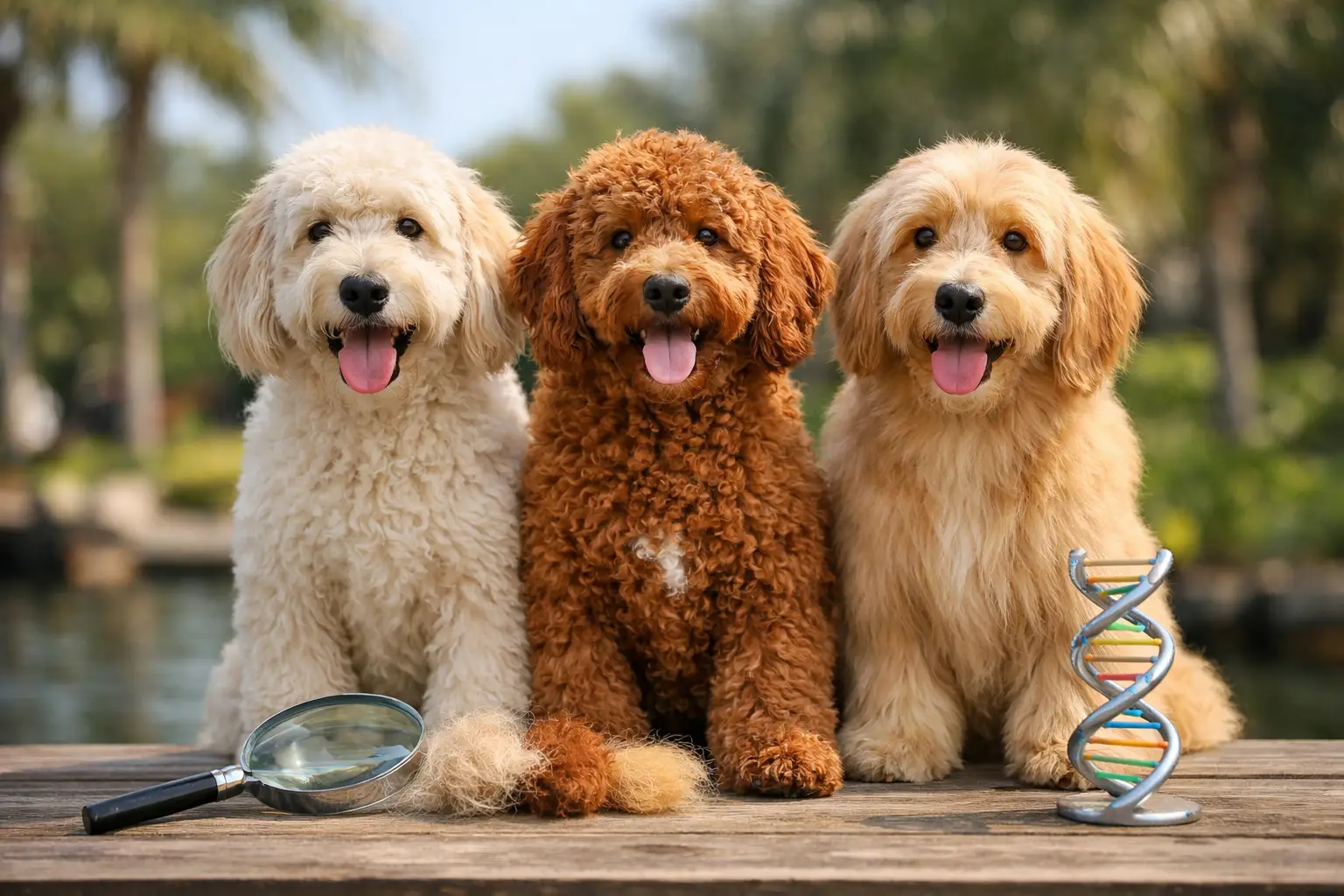
Goldendoodles can range from minimal shedding to more noticeable shedding. Even within one litter, one puppy may have a curlier, lower-shedding coat while a sibling has a softer, wavier coat that releases more hair.
The phrase “low-shedding” is more accurate than “non-shedding.” A puppy can have a wonderful coat for a family that wants less hair in the house without any breeder making a promise nature cannot guarantee. Hormones, seasonal changes, coat transition, nutrition, and grooming routines can also affect what families notice at home.
Why F1B Goldendoodles Often Have Curlier Coats
At Shalom Goldendoodles by Mary, I specialize in F1B Standard and Toy Goldendoodles. An F1B Goldendoodle is produced by breeding an F1 Goldendoodle with a Poodle. Because the puppy has a greater Poodle influence, this generation often has a curlier coat and a stronger chance of being low-shedding than some other Goldendoodle generations.
“Often” is the key word. Genetics offer probabilities, not a paint-by-number guarantee. A thoughtful breeding program looks beyond a label such as F1B and pays attention to the specific parents. A curly, furnished Poodle parent and the coat traits of the Goldendoodle parent provide a much more useful picture than generation alone.
For families, this can be reassuring: choosing an F1B may be a sensible starting point if a low-shedding coat is high on your wish list. But it is equally important to be ready for the grooming responsibilities that frequently come with that coat.
Puppy Coat Versus Adult Coat
One of the sweetest surprises of raising a Goldendoodle is seeing the adult coat emerge. Puppies are born with a soft, fine coat that can make nearly every puppy look extra fluffy. As they grow, usually during the first year or so, the adult coat begins to replace it.
This transition can make the coat look uneven, fuzzy, or more tangled for a season. Some puppies become curlier than they appeared early on. Others keep a softer wave. Color can also change. Reds may soften into apricot or cream, dark shades may fade, and black coats can develop lighter tones over time.
I always encourage families to prepare for this stage before it arrives. A slicker brush, a metal comb, gentle handling, and a positive routine make a real difference. If brushing is only done when mats have already formed, it can become uncomfortable for the dog and stressful for the family.
Color Genetics Add Another Layer
Goldendoodles come in many beautiful colors, including cream, apricot, red, chocolate, black, and combinations with white markings. Color is influenced by a separate set of genes from the ones most associated with curl and furnishings.
That means a red puppy is not automatically curlier, and a black puppy is not automatically lower-shedding. Color and coat texture are different parts of the genetic picture. Families who have their hearts set on a certain color should also be open to learning about the puppy’s likely adult shade, because fading and clearing are common in many lines.
I think a puppy’s color should bring joy, but temperament and health should always come first. The puppy who melts your heart may not be the exact shade you first imagined, yet may be the companion who fits your home beautifully.
What Responsible Breeding Can and Cannot Predict
Responsible breeders do not guess blindly about coats. We study parent dogs, observe previous puppies when possible, use appropriate health and genetic information, and communicate clearly about expected outcomes. We can often make well-informed predictions about coat texture, curl, furnishings, color possibilities, and shedding potential.
But a breeder cannot honestly guarantee every detail of an adult coat from a tiny puppy. Genes interact in ways that can create delightful variation, even among siblings. Families deserve transparency about that uncertainty, not unrealistic promises.
When you speak with a breeder, ask about the parent dogs’ coats, the generation, the likely grooming needs, and how puppies from similar pairings have matured. If allergies are a major concern, spending time around the specific breed or adult dogs before bringing a puppy home can be a wise step.
Choosing the Right Coat for Your Routine
The best Goldendoodle coat is not necessarily the curliest one or the one with the most impressive puppy fluff. It is the coat your family can comfortably care for over the years ahead. A busy household that loves a full, curly doodle coat may need to schedule regular grooming appointments and make brushing part of the weekly routine. A family that prefers a shorter, practical haircut can still enjoy a soft, lovable doodle without maintaining a long coat year-round.
I encourage families to think ahead about beach days, Florida rain, muddy paws, children learning to brush gently, and how much time they can realistically give to coat care. There is no wrong answer. There is simply a better match for your home and your rhythm.
A Goldendoodle’s coat may be one of the first things you notice, but the love behind those bright eyes is what stays with a family. With clear expectations, patient grooming, and a puppy chosen with care, that beautiful coat becomes one more small part of the life you build together.