

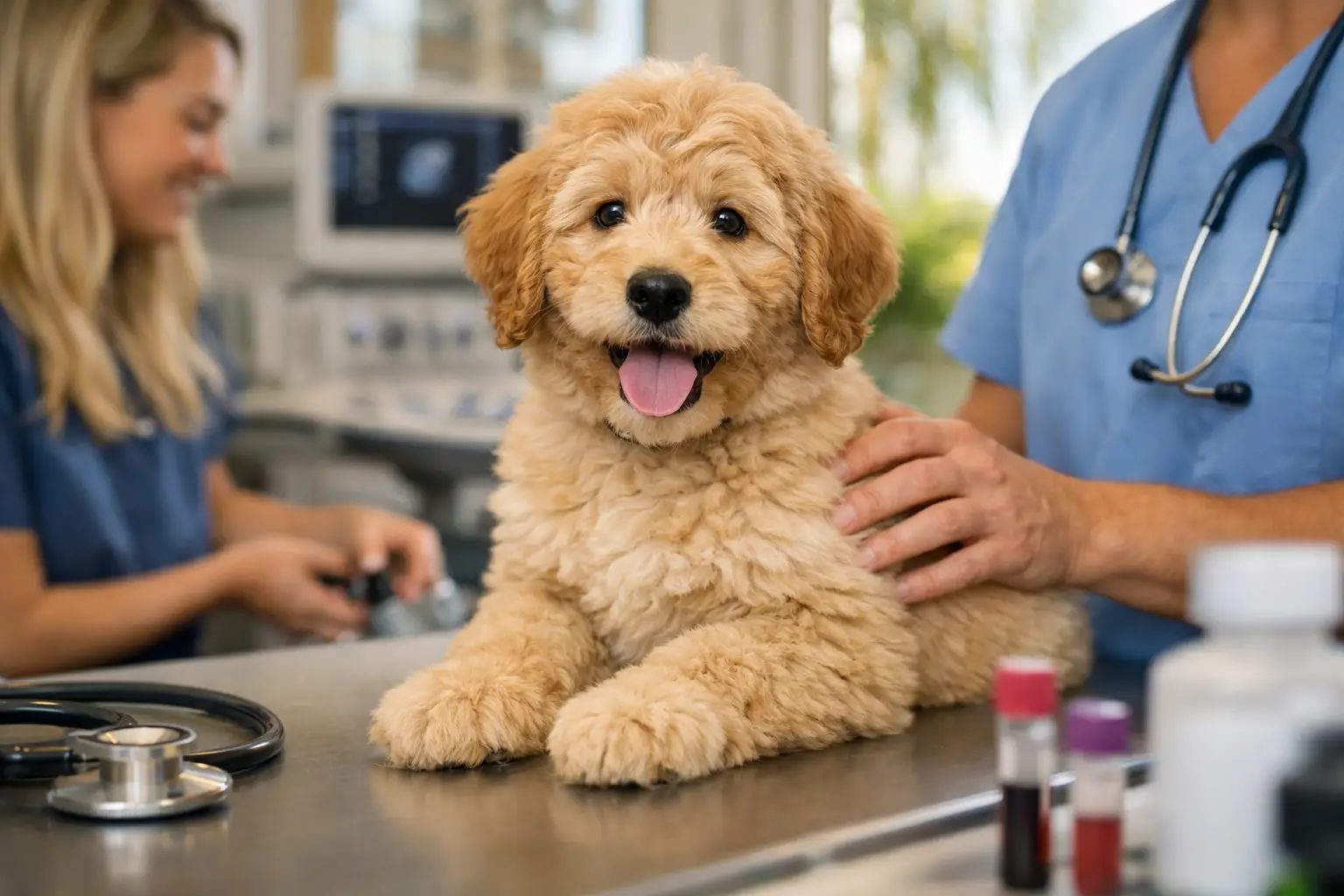
A sweet face and a soft, curly coat may be what first captures your heart, but a puppy’s health background deserves just as much attention. Goldendoodle health testing gives families a clearer picture of the care and planning behind a litter. It is one of the best ways to begin the search for a future family companion with confidence rather than guesswork.
As a breeder, I believe families should feel comfortable asking questions about health testing. A responsible breeder should welcome those conversations. The goal is not to promise that any puppy will never have a health concern – no one can honestly make that promise – but to make thoughtful breeding choices that reduce avoidable risks and give puppies the healthiest possible start.
What Goldendoodle Health Testing Really Means
Health testing usually begins long before puppies arrive. It means evaluating the parent dogs for inherited conditions and physical concerns that may be passed down through a family line. Since Goldendoodles have Golden Retriever and Poodle ancestry, a careful breeding plan considers the health considerations associated with both breeds.
Testing is different from a routine veterinary exam. A vet check is very valuable and helps confirm that a dog appears healthy at that point in time. Health screening, however, may include specialized evaluations of joints, eyes, heart health, and DNA. Together, these records help a breeder make better decisions about which dogs should be paired.
For families, the most helpful mindset is simple: ask what has been tested, ask to understand the results, and ask how those results guided the breeding decision. Clear communication matters much more than complicated terminology.
The Parent Health Screenings That Matter
The right testing plan depends on each parent dog, its size, breed background, and family history. Standard and Toy Goldendoodles do not always have the same considerations. A responsible breeder should tailor screening to the dogs being bred instead of treating every test as a one-size-fits-all checklist.
Common areas of Goldendoodle health testing include the following:
- Hips and elbows: These evaluations look for signs of joint issues, including hip or elbow dysplasia. Larger dogs can be especially affected by joint health, which is why screening is an important part of planning Standard Goldendoodle litters.
- Patellas: The patella is the kneecap. Patellar evaluations are often especially relevant for smaller dogs and can help identify kneecap instability.
- Eyes: A professional eye examination can screen for certain inherited eye concerns. Healthy-looking eyes at home are wonderful, but a formal evaluation provides a more complete picture.
- Heart health: Depending on the parent dogs and their lines, a cardiac evaluation may be recommended to screen for inherited heart conditions.
- DNA testing: Genetic testing can identify whether a parent is clear, a carrier, or genetically affected for specific inherited conditions. The exact panel should reflect the Golden Retriever and Poodle backgrounds in the breeding program.
A long list of test names can feel overwhelming when you are preparing for a puppy. You do not need to become an expert overnight. What matters is knowing that the breeder understands the results and uses them responsibly.
What “Clear” and “Carrier” Mean
One of the most misunderstood parts of genetic testing is the word “carrier.” A carrier dog is not necessarily sick. In many recessive conditions, a carrier has one copy of a genetic variant but does not develop the condition itself.
Being a carrier does not automatically mean a dog should never be bred. It means the breeding decision must be carefully planned. When a carrier is paired with a genetically clear dog for that same condition, the puppies should not be genetically affected by it. Some puppies may be carriers, but they should not inherit two copies of the variant.
This is why seeing a single result without context can be misleading. Responsible breeding is about understanding both parents together, not simply searching for one perfect-looking label on a report.
Why Mixed Breed Puppies Still Need Careful Screening
Some families hear that mixed breed dogs are automatically healthier than purebred dogs. While a diverse genetic background can be beneficial in some situations, a Goldendoodle can still inherit health concerns found in either side of the family. Crossing breeds is not a substitute for health testing.
F1B Goldendoodles are created by breeding an F1 Goldendoodle with a Poodle. This generation is often loved for its curlier, lower-shedding coat, but coat type should never take priority over health and temperament. The Poodle parent’s health background remains especially meaningful, while the Goldendoodle parent brings its own Golden Retriever and Poodle lineage to consider.
Thoughtful testing is one piece of responsible breeding. It works alongside strong temperaments, sound structure, age-appropriate veterinary care, good nutrition, clean living conditions, and careful puppy socialization. Families deserve to know that all of these pieces matter.
Questions I Encourage Families to Ask
Bringing home a puppy is a long-term commitment, so there is no need to feel shy about asking direct questions. A caring breeder will understand that you are trying to protect your future family member.
You may ask which health tests were completed on both parents, whether you can review the results, and whether there is a history of any health concerns in the lines. It is also reasonable to ask what support is provided after your puppy comes home and what the health guarantee covers.
Pay attention to how the breeder responds. The best conversations are calm, clear, and honest. No breeder can guarantee that life will never bring a veterinary surprise, just as no parent can guarantee a child will never get sick. What a responsible breeder can do is be transparent about their practices, stand behind their puppies, and remain available as questions arise.
At Shalom Goldendoodles by Mary, I want every family to feel informed, never pressured. I raise puppies in my home, where I can watch their early development closely and give them daily care and attention. Health-focused breeding begins with the parents, but loving observation and a safe family environment matter from the day each puppy is born.
Health Testing Is Not the Whole Story
Test results are powerful tools, but they cannot predict every part of a dog’s future. Injuries, nutrition, exercise habits, dental care, weight management, parasites, and routine preventive care all affect lifelong wellness. A well-bred puppy still needs a family ready to provide regular veterinary care, training, quality food, appropriate exercise, and lots of love.
For growing Goldendoodles, it is wise to avoid pushing them too hard with repetitive, high-impact exercise while their bodies are developing. Keeping a dog at a healthy weight is also one of the kindest things a family can do for its joints. These everyday choices add up over the years.
Temperament deserves attention, too. A puppy who is raised with gentle handling, everyday household sounds, and positive early experiences has a better foundation for becoming a confident companion. Health is not only about a report or a test result. It is also about giving a puppy a secure, well-cared-for beginning.
Looking Beyond a Puppy’s First Day Home
When you choose a Goldendoodle, you are choosing a companion for many years of muddy paws, happy greetings, couch cuddles, walks, and family memories. Health testing cannot remove every uncertainty, but it shows that the breeder has put care, knowledge, and responsibility ahead of convenience.
Take your time, ask the questions that matter to your family, and choose a breeder who treats those questions with respect. The right puppy should come with more than excitement – they should come with a caring foundation and people who want to support you as your new best friend grows into a treasured part of your home.