

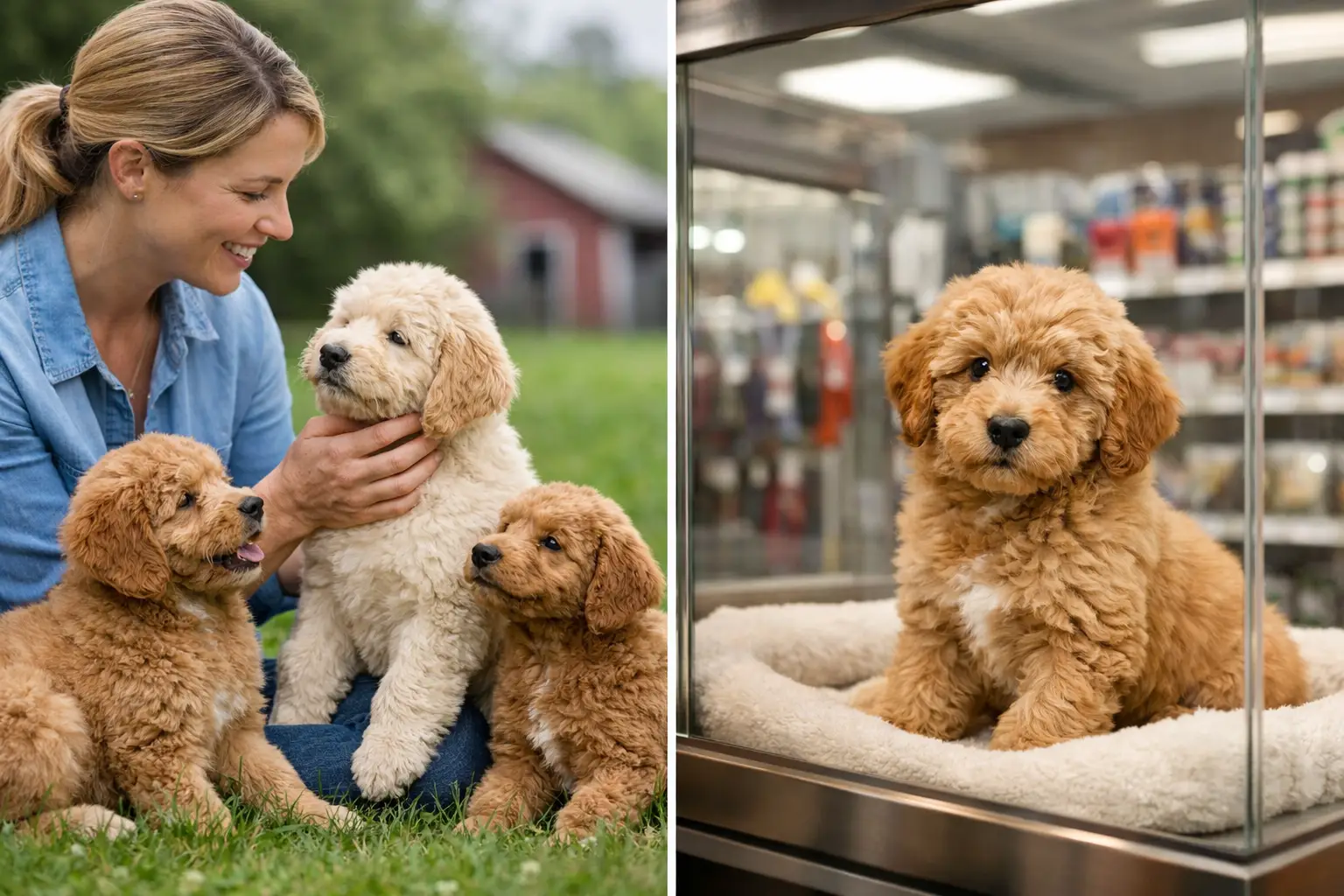
Bringing home a Goldendoodle is exciting, but the choice between a goldendoodle breeder vs pet store can shape your family’s experience for years to come. I have talked with many families who started by looking at puppy listings and cute photos, only to realize they also needed answers about health, temperament, socialization, and what kind of support they would have after bringing their puppy home.
That is where the difference really begins. A puppy may look adorable whether you meet them in a shop window or through a breeder, but how that puppy was raised matters deeply. If you are choosing a future family companion, not just a puppy for the moment, it helps to understand what is happening behind the scenes.
Goldendoodle breeder vs pet store: what changes for your family?
The biggest difference is not just where you pick up your puppy. It is how the puppy was bred, raised, handled, and prepared for family life.
With a responsible breeder, you should be able to learn about the puppy’s parents, health background, early care, and living environment. You should also be able to ask questions and get clear answers. A good breeder knows each puppy as an individual and can help match the right personality to the right home.
At a pet store, families often see the puppy first and the background second. Sometimes the store staff may know basic details, but they usually did not raise the puppy themselves. That can make it harder to know how the puppy was socialized, what the parent dogs are like, or whether the breeder behind the scenes followed careful health and temperament standards.
That does not mean every pet store puppy will have problems or that every breeder is excellent. It does mean families should look beyond the surface and ask who raised this puppy, how they were raised, and who will still care after the sale is over.
Health starts long before pickup day
One of the most important things I encourage families to ask about is health testing. Goldendoodles are wonderful companions, but like any dog, they deserve thoughtful breeding practices. Good breeding is not simply pairing two pretty dogs. It means paying attention to structure, temperament, genetics, and overall wellbeing.
A breeder should be able to explain the health care and veterinary attention the puppies receive, along with the health background of the parent dogs. Families should also ask whether puppies are checked by a veterinarian, kept on a vaccination and deworming schedule, and sent home with clear records.
A pet store may provide some paperwork, but often there is a middle layer between the family and the actual breeder. That separation can make transparency harder. If you cannot easily learn about the parents or the environment the puppy came from, that is worth taking seriously.
Health is also about stress. Puppies that are moved through multiple locations at a very young age can experience more strain than puppies raised consistently in one home environment. Early stress does not guarantee a bad outcome, but it can affect adjustment, confidence, and even immune response.
Why early socialization matters so much
For many families, temperament is just as important as health. You want a puppy that can grow into a loving, stable companion around children, guests, other pets, and everyday household life.
That is why I always come back to how a puppy is raised in those first weeks. A family-raised puppy is exposed to normal home sounds, daily handling, gentle routines, and regular human interaction. That kind of start helps puppies become more confident and adaptable.
The home environment makes a difference
When puppies are raised inside a home, they begin learning the rhythm of family life early. They hear voices, experience touch, and become familiar with the little things that make up everyday living. That can help the transition into their new home feel less overwhelming.
In a pet store setting, puppies may spend more time in display areas, enclosures, or high-traffic environments that are not the same as home life. Some puppies handle that well. Others may feel overstimulated or shut down. The challenge is that families often meet the puppy for a short time and may not see the full picture of that puppy’s early development.
Socialization is not the same as exposure
Simply seeing lots of people is not the same as thoughtful socialization. Good socialization includes gentle handling, positive experiences, age-appropriate exposure, and careful observation of each puppy’s comfort level.
A responsible breeder can usually tell you more than just who is available. They can often tell you which puppy is more laid back, which one is playful, which one enjoys children, and which one may need a quieter home. That kind of guidance is very hard to get from a retail setting.
Support after you bring your puppy home
This is one of the most overlooked parts of the goldendoodle breeder vs pet store conversation. Families are often so focused on pickup day that they do not think about the weeks after.
The truth is, the first days and months matter a lot. New puppy families have questions about crate training, feeding, house training, grooming, sleeping routines, and normal adjustment. It is reassuring to know you can reach out to someone who knows your puppy’s background.
A caring breeder usually sees the relationship as ongoing. They want updates, they answer questions, and they care about where their puppies go. That support can be especially helpful for first-time dog owners or families with young children.
A pet store may have a return policy or customer service process, but that is not the same as lifelong breeder support. One is transactional. The other is relational.
What families should ask before making a decision
Whether you are talking to a breeder or a store, ask direct questions. Who raised this puppy from birth? Can I learn about the parents? What health care has the puppy received? How has the puppy been socialized? What kind of support is available after I bring the puppy home?
Pay attention not only to the answers, but also to how those answers are given. Clear, patient, honest communication matters. If someone becomes vague, defensive, or rushed when you ask reasonable questions, that tells you something.
A good breeder should welcome thoughtful questions because they want informed, prepared families. In my experience, that is usually a sign that they care deeply about where their puppies are going.
Goldendoodle breeder vs pet store: when convenience is not the best guide
Pet stores can feel convenient. You may be able to see puppies quickly, make a fast decision, and take one home without much waiting. I understand why that appeals to people, especially when they have fallen in love with the breed.
But convenience should never be the main factor in choosing a puppy. A dog becomes part of your family for many years. It is worth slowing down for good information, good care, and a good start.
Sometimes families worry that working with a breeder will be complicated or intimidating. A good breeder should not make you feel pressured. You should feel welcomed, informed, and respected. The process should help you prepare, not push you.
That personal connection can make all the difference. At Shalom Goldendoodles, I believe families deserve to know how their puppy was raised and to feel supported every step of the way.
The best choice depends on transparency and care
There is no value in choosing a breeder just because they are a breeder if they do not raise puppies responsibly. And there is no value in choosing a store just because it is nearby if important questions go unanswered. Labels matter less than practices, but responsible home-raised breeding offers families a level of transparency and relationship that is often hard to match in a retail setting.
If you are looking for a Goldendoodle with a strong foundation, ask yourself where you feel the most trust. Where can you clearly see the care behind the puppy? Where do you feel like your future dog is being treated as a life to be nurtured, not inventory to be moved?
That answer usually points families in the right direction.
A puppy will only be little for a short season, but the start they receive stays with them. Take your time, ask good questions, and choose the path that gives your new companion the healthiest, happiest beginning possible.