If you are comparing f1b vs f1 goldendoodle, you are probably already picturing life with a sweet, playful puppy curled up at your feet. This is one of the most common questions families ask me, and it is a good one. The right choice often comes down to your home, your grooming expectations, and whether shedding is a big concern for your family.
Both F1 and F1B Goldendoodles can make wonderful companions. They are known for being affectionate, smart, social, and eager to be part of family life. But there are some meaningful differences between the two, especially when it comes to coat type, maintenance, and how predictable certain traits may be.
What is the difference between F1B vs F1 Goldendoodle?
Let’s keep this simple. An F1 Goldendoodle is a first-generation cross between a Golden Retriever and a Poodle. That means the puppy is about 50 percent Golden Retriever and 50 percent Poodle.
An F1B Goldendoodle is produced by breeding an F1 Goldendoodle back to a Poodle. The “B” stands for backcross. Because of that, an F1B puppy usually has more Poodle influence in its coat and overall traits.
That one breeding difference affects several things families care about most. Coat texture is usually the biggest one, but it can also influence shedding, allergy friendliness, and grooming needs.
Coat type is often the biggest factor
When families ask me about f1b vs f1 goldendoodle, they are usually really asking about the coat.
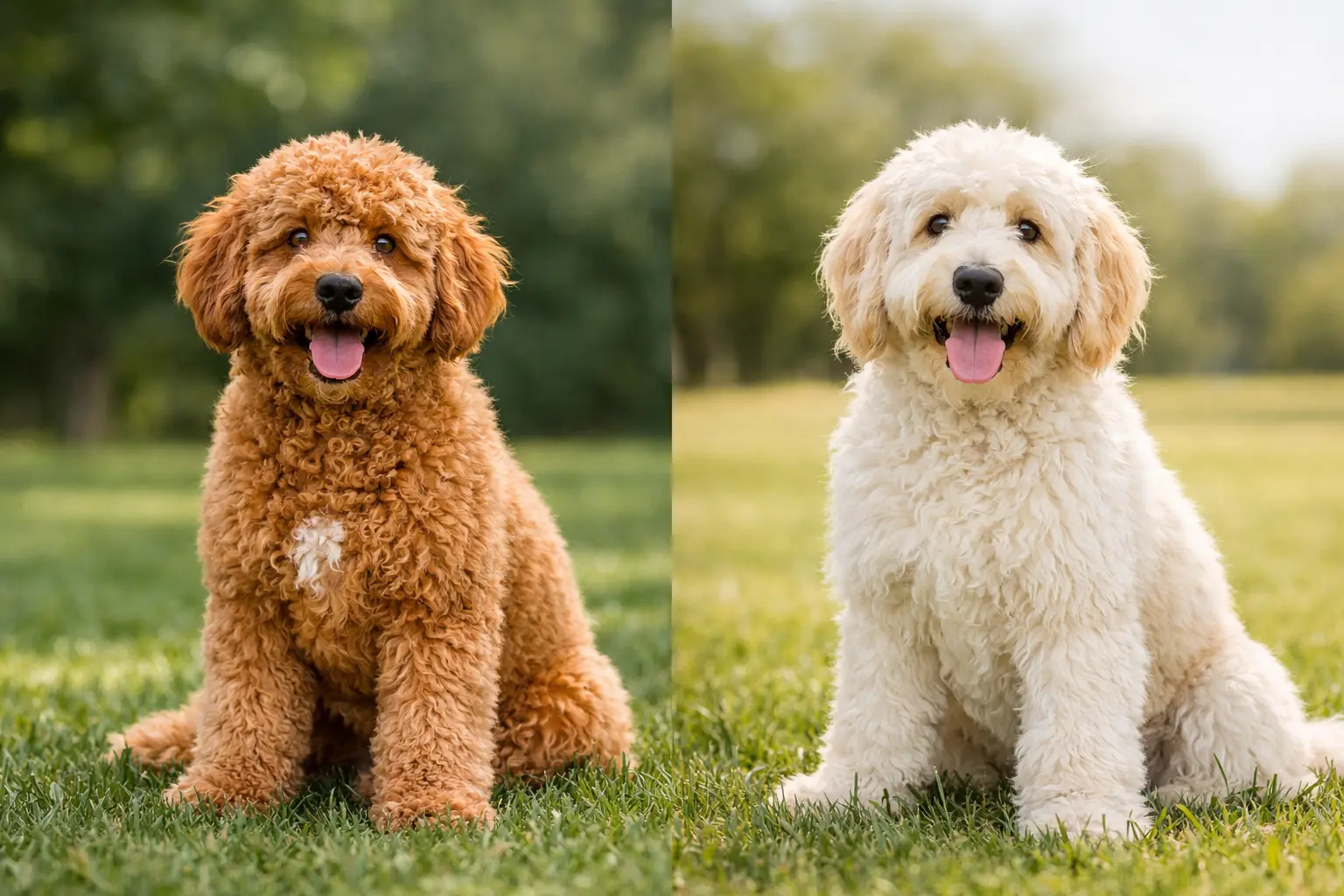
F1 Goldendoodles often have wavy or shaggy coats. Some will lean more toward the Golden Retriever side, while others show more of the Poodle side. Their coats can be beautiful and fluffy, but they tend to be a little less predictable from puppy to puppy.
F1B Goldendoodles usually have curlier coats because of the stronger Poodle influence. That curlier coat is often what families are looking for when they want a lower-shedding puppy. It also gives many F1B puppies that soft, teddy bear look people love.
Neither generation is completely maintenance-free. That is an important truth. A curlier coat may shed less, but it also needs regular brushing and grooming to stay healthy and mat-free.
Which coat sheds less?
In general, F1B Goldendoodles are more likely to be low-shedding than F1 Goldendoodles.
F1 puppies can still be low-shedding, but there is usually more variation. Some F1 coats do very well in families wanting less hair around the house, while others may shed more than expected. If your family is especially concerned about shedding, the F1B generation is often the safer choice.
That said, no dog can be promised as completely hypoallergenic. People have different allergy sensitivities, and reactions can come from dander, saliva, and other factors, not just fur. I always encourage families to think in terms of lower shedding rather than allergy-proof.
Temperament differences are usually smaller than people expect
A lot of people assume that F1 and F1B Goldendoodles have very different personalities. In my experience, the difference is often less dramatic than the coat difference.
Both generations are typically loving, intelligent, friendly, and eager to be with their people. Goldendoodles in general tend to do beautifully in family homes because they are social dogs. They want to be included. They thrive on attention, consistency, and connection.
An F1 Goldendoodle may sometimes show a little more of that easygoing Golden Retriever charm, while an F1B may sometimes reflect more of the Poodle’s alertness and trainability. But temperament is shaped by more than generation alone. Good breeding, early socialization, and the environment a puppy is raised in all matter deeply.
That is one reason I believe so strongly in raising puppies inside the home. Early exposure to normal household sounds, daily handling, and human interaction helps puppies become confident and well-adjusted.
Grooming needs matter more than many families realize
This is where I like to be very honest. Families are often drawn to Goldendoodles because they want a beautiful, low-shedding companion. That makes sense. But the trade-off is grooming.
F1 Goldendoodles with looser waves may be a little easier to brush through, depending on the individual coat. F1B Goldendoodles, especially those with tighter curls, often need more frequent brushing to prevent tangles and mats. Professional grooming is usually part of life with either one, but it is especially important with curlier coats.
If you want the lowest possible shedding, you may need to be ready for more coat care. If you prefer a slightly easier brushing routine, you may be comfortable with a coat that sheds a bit more. That is why there is no one-size-fits-all answer.
A realistic grooming routine
Most Goldendoodle families should expect regular brushing several times a week, plus professional grooming on a routine schedule. Waiting too long between grooming appointments can make coat care stressful for both you and your dog.
A well-maintained coat is not just about appearance. It keeps your puppy comfortable and helps avoid painful matting close to the skin.
Which is better for families with allergies?
This question comes up often, and I always try to answer it carefully.
If you are comparing f1b vs f1 goldendoodle because someone in your home has mild allergies, an F1B is often the more appealing option. The stronger Poodle influence usually means a curlier, lower-shedding coat, and that can help some families.
Still, there are no guarantees. One person may do well with an F1 and another may only tolerate an F1B. Someone else may still react to both. If allergies are a serious issue in your home, it is wise to think carefully and speak with your medical provider as part of the decision.
Size and appearance can vary too
Both F1 and F1B Goldendoodles come in different sizes depending on the parents. In standard Goldendoodles, many families can expect a medium-to-large companion, though exact adult size always depends on genetics.
Appearance also varies within both generations. F1 puppies may have more of that tousled, retriever-style look or a softer wave. F1B puppies often have a more consistently curly and plush appearance. Some families know exactly which look they love. Others are more focused on temperament, trainability, and coat practicality.
Both are perfectly reasonable ways to choose.
How to decide between F1B vs F1 Goldendoodle
The best choice usually comes down to what matters most in your everyday life.
If lower shedding is at the top of your list, and you do not mind regular grooming, an F1B Goldendoodle may be the better fit. This is a big reason so many families are drawn to F1B puppies.
If you like a slightly looser coat, are comfortable with a bit more unpredictability in shedding, and love the balanced Golden Retriever and Poodle mix of an F1, that generation may suit your family beautifully.
I also encourage families to think about their routines. Do you have time for brushing? Are you ready to schedule regular grooming? Is anyone in the home sensitive to pet hair? Do you want a more curly coat or a more wavy one? Those practical questions usually bring clarity pretty quickly.
My honest advice to puppy families
When families ask me which is better, I do not like to give a one-word answer because better depends on your home.
For many households, especially those wanting a low-shedding family companion, F1B Goldendoodles are a wonderful choice. They are intelligent, affectionate, beautiful, and often a great match for families with children or first-time dog owners who want a loving companion that fits closely into daily life. That is one reason I love raising them.
At the same time, F1 Goldendoodles are also wonderful dogs. They can be playful, gentle, and deeply devoted to their people. Some families truly prefer that coat style and that first-generation mix.
The goal is not to pick the most popular option. The goal is to choose the puppy that best fits your family, your expectations, and your lifestyle. A good breeder should help you think through that honestly, not pressure you into one answer.
If you are still deciding, give yourself permission to ask questions and take your time. The right puppy is not just a pet. It is a family member, and the best match is the one that brings peace, joy, and confidence to your home from the very beginning.


[…] Shalom Goldendoodles, I specialize in F1B Goldendoodles, which are produced by crossing an F1 Goldendoodle with a Poodle. Because they have a higher […]
[…] lower-shedding coat is one of the most common reasons families consider a Goldendoodle. F1B Goldendoodles, which have a Goldendoodle parent and a Poodle parent, often have curlier coats and may shed less […]
[…] F1B Goldendoodles often have curlier, lower-shedding coats because they have more Poodle influence. Hair that does not shed freely can remain caught in the coat. As loose hair mixes with moisture, dirt, friction, and active puppy play, it begins to twist around healthy hair and form tangles. […]
[…] nature, while Poodles are admired for their intelligence and low-shedding coats. In an F1B Goldendoodle, the Poodle influence is often stronger, which can mean a curlier coat and less shedding than some […]
[…] can have wavy, curly, or somewhere-in-between coats. F1B Goldendoodles, including the Standard and Toy puppies I raise, often have curlier, lower-shedding coats because […]
[…] families who are looking for an F1B Standard or Toy Goldendoodle, a breeder can often offer helpful guidance about likely adult size, coat care, energy level, and […]