A doodle label can look like a little bit of alphabet soup when you are trying to choose a puppy. F1, F1B, F1BB, and multigenerational are not ratings for which puppy is “best.” They simply describe the breeding history behind a litter. Knowing how to compare doodle generations helps you ask better questions and choose the puppy whose needs fit naturally into your family’s everyday life.
As a Goldendoodle breeder, I encourage families to look past the letters alone. A generation can offer helpful clues about coat type and shedding, but a puppy’s health, temperament, parent dogs, early care, and the match with your household matter just as much.
Start With What the Letters Mean
The “F” in doodle generations means filial, or offspring from a cross. The number tells you how far removed the puppy is from the original purebred pairing. The “B” means backcross, which usually means a doodle has been bred back to a Poodle.
For Goldendoodles, the original pairing is a Golden Retriever and a Poodle. That foundation matters because both breeds contribute wonderful qualities. Golden Retrievers are known for their affectionate, people-loving nature, while Poodles are bright, athletic, and often valued for their lower-shedding coats.
Here is the simple family tree behind the labels:
| Generation | Typical Parent Pairing | What It Means | | — | — | — | | F1 | Golden Retriever + Poodle | First-generation Goldendoodle | | F1B | F1 Goldendoodle + Poodle | A backcross Goldendoodle | | F1BB | F1B Goldendoodle + Poodle | A second backcross Goldendoodle | | Multigenerational | Goldendoodle + Goldendoodle, with varied lineage | A later-generation doodle |
These labels are useful shorthand, but they do not tell the whole story. Two F1B puppies from different litters may have different curl patterns, adult sizes, energy levels, and personalities. Even littermates can be wonderfully different from one another.
How to Compare Doodle Generations by Coat and Shedding
For many families, coat and shedding are the first reasons to compare doodle generations. This is where an F1B Goldendoodle is often especially appealing.
An F1 Goldendoodle has one Golden Retriever parent and one Poodle parent. Their coats can range from loose waves to curls, and shedding can vary from light to more noticeable. Some F1 dogs are a lovely fit for families who enjoy the classic shaggy doodle look and are comfortable with some unpredictability in the coat.
An F1B Goldendoodle comes from an F1 Goldendoodle bred to a Poodle. Because there is more Poodle influence in the pairing, F1B puppies often have curlier or wavier coats and tend to be low-shedding to minimal-shedding. This is one reason I specialize in F1B Standard and Toy Goldendoodles. Many families appreciate the combination of a loving Goldendoodle personality with a coat that is often a better fit for lower-shedding households.
F1BB and some multigenerational doodles may also have very curly, Poodle-like coats. While that may appeal to families looking for a low-shedding companion, a curlier coat usually requires a committed grooming routine. Lower shedding does not mean lower maintenance. In fact, it often means regular brushing, professional grooming appointments, and careful attention to prevent mats close to the skin.
No responsible breeder should promise that any doodle is completely hypoallergenic or guaranteed not to trigger allergies. Allergies are personal, and reactions can be caused by dander, saliva, and other factors beyond loose hair. If allergies are a concern in your home, spend time around adult dogs with similar coats when possible, and speak openly with the breeder about the puppies and their parents.
Consider Size Before You Fall in Love With a Photo
Generation alone does not determine how big a doodle will become. The sizes of both parents are much more helpful. A Standard Poodle paired with an F1 Goldendoodle can produce a very different adult size than a Miniature or Toy Poodle pairing.
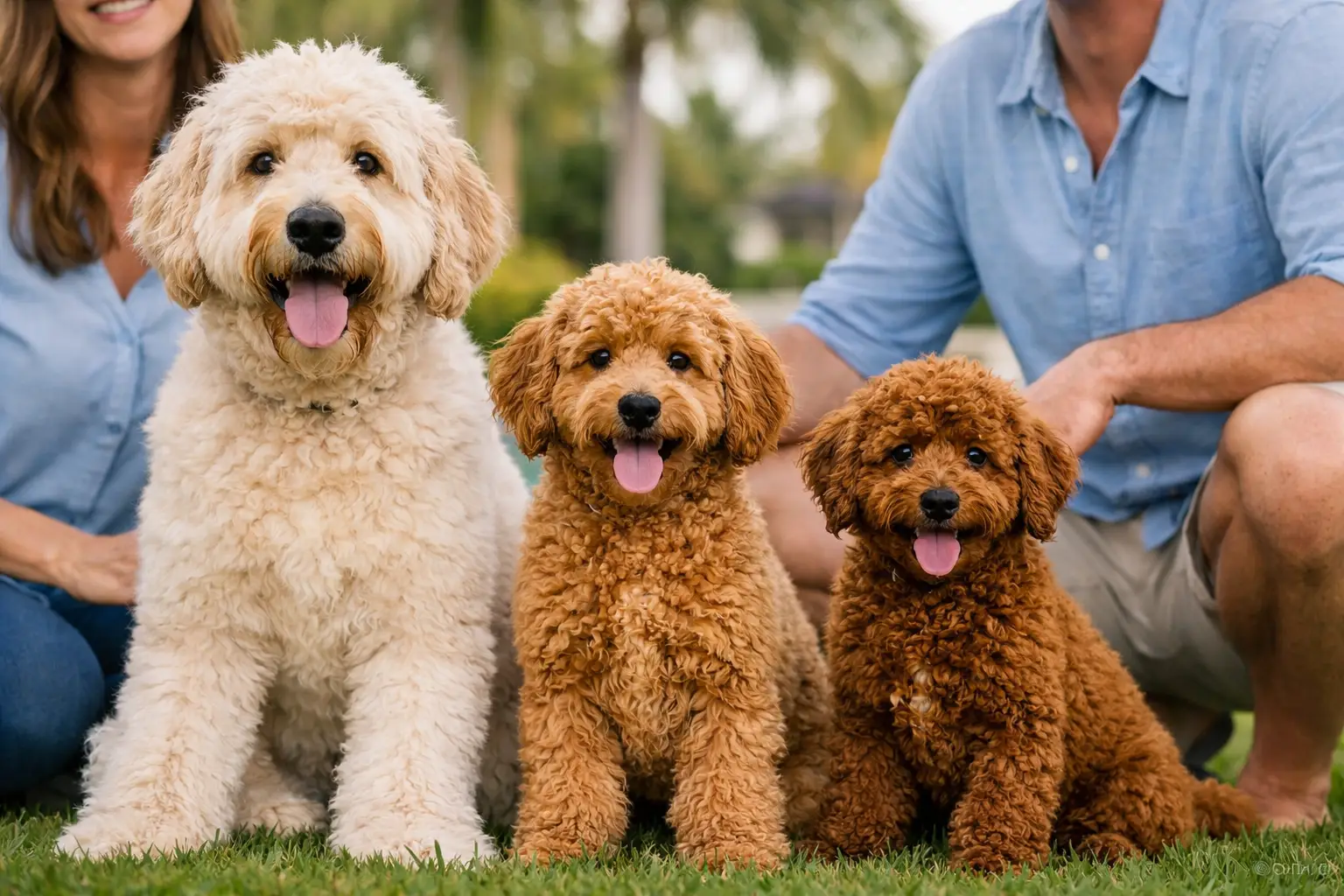
My F1B Standard Goldendoodles typically grow into dogs around 50 to 70 pounds. They are a wonderful choice for families who want a substantial, active companion for walks, playtime, outings, and relaxed evenings at home. They need room to move and daily interaction, but they do not need a perfect or oversized house. They need a family committed to including them.
F1B Toy Goldendoodles offer a smaller companion for households that prefer a more compact dog. They can be easier to travel with and may suit apartments or smaller homes well. Still, small does not mean fragile or inactive. These are intelligent, affectionate dogs that need training, play, and companionship just like their larger relatives.
When comparing litters, ask about the expected adult weight range, not just the puppy’s current size. A tiny eight-week-old puppy can grow into a much larger dog than a family expects.
Temperament Is About More Than Generation
Families often ask whether one doodle generation has a better temperament than another. The honest answer is that it depends. Generations can influence the likelihood of certain coat traits, but temperament is shaped by much more than a label.
I look at the personalities and stability of the parent dogs, their health history, and how puppies are raised during their earliest weeks. Puppies raised inside a family home hear everyday sounds, experience gentle handling, and begin learning that people are safe and comforting. That kind of early foundation matters when a puppy joins a home with children, visitors, routines, and plenty of loving activity.
Poodle influence can bring intelligence, alertness, and an eagerness to learn. Golden Retriever influence often contributes warmth, sociability, and a strong desire to be close to people. But every puppy is an individual. One may be a confident little social butterfly, another may be cuddly and observant, and another may be the first to investigate every new toy.
For a first-time dog owner, a calm, people-focused puppy with a good early start may be a better match than simply choosing the generation with the lowest-shedding description. For an active family, a bright puppy who enjoys engagement and training may be a lovely fit. The right match is about your real life, not a trend or a photo.
Compare Grooming and Daily Care Honestly
Before choosing a doodle generation, picture the practical parts of life with your future dog. Curly and wavy coats are beautiful, but they need regular care. Brushing should become part of your family routine, especially around the ears, collar area, legs, and tail where tangles can form.
A lower-shedding F1B or F1BB may be a strong choice for families prepared to keep up with grooming. An F1 with a looser coat may sometimes be easier to brush, though shedding can be less predictable. There is a trade-off, and neither choice is wrong. The best choice is the one you can care for consistently and lovingly.
All doodles also need training, exercise, quality nutrition, veterinary care, and companionship. They are happiest as part of family life, not as dogs left alone without connection for long stretches. A generation label cannot replace the daily commitment of welcoming a dog into your home.
Look Closely at the Breeder, Not Just the Generation
A beautiful puppy description should always lead to thoughtful questions. Ask a breeder about health testing for the parent dogs, veterinary care for the litter, the puppy’s socialization, and what support is available after your puppy goes home. Ask to learn about the parents’ temperaments and expected adult size. A caring breeder should welcome those conversations.
I believe families deserve transparency because a puppy is not a purchase you make lightly. This little dog will grow up alongside your children, greet you after hard days, join your routines, and become part of your memories. At Shalom Goldendoodles, I raise puppies inside my home and want every family to feel informed, supported, and comfortable as they prepare for that responsibility.
Health testing and early care do not guarantee that a dog will never face a health concern. Living beings do not come with absolute promises. But responsible breeding, vet care, thoughtful pairings, and honest communication give puppies the healthiest possible start and give families a clearer picture of the commitment ahead.
Choose the Puppy That Fits Your Home
If low shedding is a high priority and you are ready for regular grooming, an F1B Goldendoodle may be an excellent place to start. If you are open to more coat variation and possibly some shedding, an F1 may be a lovely option. If you are considering a very curly F1BB or multigenerational doodle, make sure you are comfortable with the additional grooming that can come with that coat.
Then look beyond the letters. Think about size, activity level, children or other pets, your work schedule, travel plans, and the type of relationship you hope to have with your dog. A healthy, well-raised puppy from thoughtfully selected parents is far more meaningful than a label by itself.
The sweetest part of this decision is that you are not simply comparing generations. You are preparing to welcome a future family member, and taking the time to choose carefully is one of the first loving things you can do for that puppy.



[…] Goldendoodles are often called more allergy-friendly than many other Goldendoodle generations because of their genetic makeup. An F1B puppy comes from an F1 Goldendoodle bred to a Poodle. In […]