

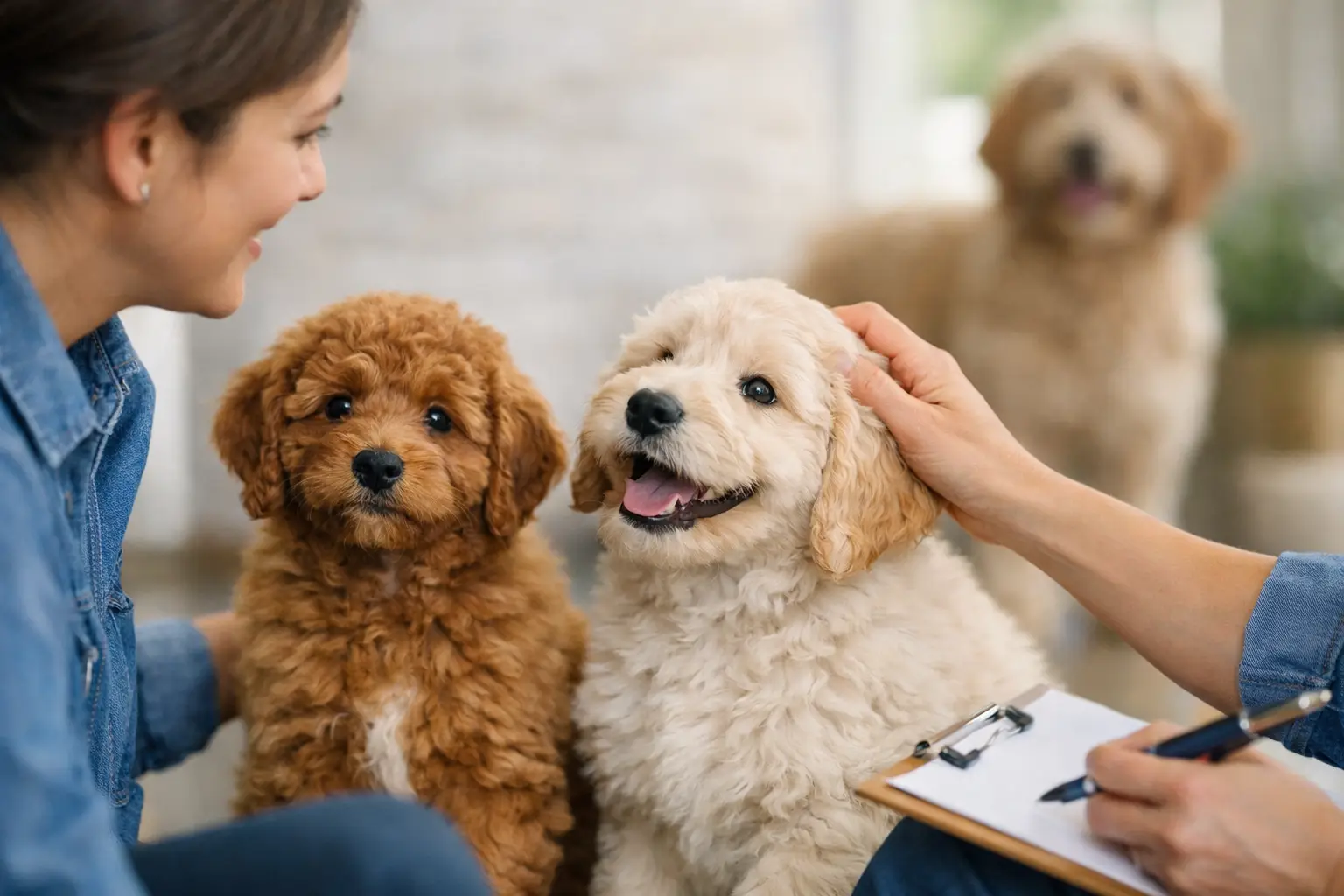
The moment you start talking with a breeder, you can usually feel the difference. Some conversations feel rushed and sales-focused. Others feel open, caring, and honest. If you are looking for the right questions for goldendoodle breeder conversations, the goal is not to sound suspicious – it is to make sure your future puppy is being raised with health, purpose, and love.
A Goldendoodle will become part of your family for many years. That means the breeder matters just as much as the puppy itself. Good questions help you understand how the puppies are raised, what kind of support you can expect, and whether the breeder truly puts the dogs first.
Why these questions for goldendoodle breeder visits matter
When families reach out to me, I always welcome thoughtful questions. In fact, I appreciate them. A responsible breeder should be happy to explain how they raise their puppies, what health testing they do, and what families can expect after bringing a puppy home.
The right breeder is not just producing puppies. They are shaping early temperament, socialization, and lifelong health foundations. That is especially important for families with children, first-time dog owners, or anyone hoping for an easy transition into home life.
12 questions to ask before choosing a breeder
1. Are the parent dogs health tested?
This should be one of the first things you ask. Health testing goes beyond a basic vet visit. You want to know whether the parent dogs have been evaluated for genetic concerns and breed-related issues.
A trustworthy breeder should be able to clearly explain what testing has been done and why it matters. If the answer is vague, defensive, or brushed off, that is worth paying attention to.
2. Can I learn about the parents’ temperaments?
Temperament matters in everyday family life. A puppy may be adorable, but you also want to know whether the parents are friendly, stable, affectionate, and easy to live with.
Goldendoodles are loved for their social and intelligent nature, but personality is shaped by both genetics and early environment. Ask how the parent dogs behave around people, children, other dogs, and normal household activity.
3. Where are the puppies raised?
This question tells you a lot. Puppies raised inside a home are exposed to everyday sounds, routines, and human interaction in a very different way than puppies raised in isolated kennel settings.
That does not mean every small breeder is automatically excellent or every kennel setup is automatically poor. It does mean you should understand the puppy’s early world. A family-raised puppy often gets more frequent handling and a smoother start with socialization.
4. How are the puppies socialized?
Socialization is more than simply being held. Ask what the breeder is doing during those early weeks to help puppies become confident and well-adjusted.
That may include gentle handling, exposure to household sounds, time with people of different ages, early crate introduction, grooming exposure, and supervised play. A breeder should be able to describe their process in a clear and practical way.
5. What veterinary care do the puppies receive?
Before going home, puppies should receive age-appropriate care. Ask about wellness checks, vaccinations, deworming, and whether the puppy comes with health records.
This is also a good time to ask whether the puppy is microchipped and whether there is any health guarantee. A breeder who is organized and responsible should have no problem walking you through that information.
6. What generation and size can I expect?
Goldendoodles are not one-size-fits-all. Families often have questions about adult size, coat type, and shedding expectations. Ask whether the puppy is an F1, F1B, or another generation, and what that generally means for coat and size.
You should also ask for realistic expectations, not perfect promises. For example, many F1B Goldendoodles are lower shedding, but no breeder should guarantee that any dog is completely hypoallergenic for every person. Honest breeders explain tendencies, not fairy tales.
7. How do you match puppies with families?
Some families want to choose based on color or the fluffiest face. I understand that. But the best matches usually come from temperament, energy level, and lifestyle fit.
Ask whether the breeder helps guide the matching process. A breeder who knows each puppy well can often help identify which one may be a better fit for a home with young children, a quieter household, or a more active family.
8. Can I see photos, videos, or the puppy’s environment?
Transparency matters. Not every breeder offers in-person visits in the same way, especially for health and safety reasons, but there should still be a way for you to see where the puppies are being raised.
Photos and videos can tell you a lot about cleanliness, space, comfort, and the breeder’s openness. If someone avoids showing the environment at all, that is worth questioning.
9. What support do you offer after the puppy goes home?
A puppy does not stop needing guidance once it leaves the breeder. New families often have questions about feeding, crate training, grooming, sleeping routines, and the first vet visit.
Ask whether the breeder stays available after pickup day. Ongoing support is a meaningful sign that the breeder cares about each puppy beyond the transaction.
10. What is included when I bring my puppy home?
This is a practical question, but it matters. Some breeders send puppies home with health records, a small bag of food, a blanket with familiar scent, a toy, registration paperwork, and care instructions.
Knowing what is included helps you prepare and also gives you a sense of how thoughtful and organized the breeder is.
11. Do you have a contract, and what does it cover?
A responsible breeder should have a written agreement. That contract often outlines health guarantees, spay or neuter expectations, return policy, and basic responsibilities for both the breeder and the buyer.
Do not be afraid to read it carefully and ask questions. A clear contract protects everyone, especially the puppy.
12. What happens if I cannot keep the dog later?
This is one of the most important questions, and many families do not think to ask it. Life can change. A good breeder should care deeply about where their puppies end up, even years later.
Many responsible breeders want the dog returned to them or want to be involved in rehoming if a family can no longer keep the dog. That shows long-term commitment and real responsibility.
Questions for goldendoodle breeder red flags
Sometimes what matters most is not just the answer, but how the answer is given. If a breeder seems irritated by reasonable questions, avoids specifics, pressures you to send money quickly, or makes big promises without proof, slow down.
Be careful with phrases that sound reassuring but mean very little, such as saying the parents are healthy without explaining testing, or claiming puppies are family-raised without showing what that actually looks like. Warm words are lovely, but they should be backed by real practices.
Price alone should not be your deciding factor either. Raising puppies well takes time, veterinary care, quality food, cleaning, socialization, and daily hands-on effort. The cheapest option can become the most expensive if it comes with health or temperament problems later.
What a good breeder conversation should feel like
A healthy breeder-family relationship should feel respectful on both sides. You should feel comfortable asking questions, and the breeder should also be asking you questions. That is a good sign.
When I speak with families, I want to know about their home, schedule, children, activity level, and what they hope for in a puppy. That is not about making things difficult. It is about helping make the right match, because these puppies are not products on a shelf. They are little lives that deserve the best start and the best home.
The goal is confidence, not perfection
No breeder is going to be identical, and some answers will vary depending on breeding program size, location, and how visits are handled. That part can depend. What should not vary is honesty, care, and a clear commitment to the health and well-being of every puppy.
If you ask thoughtful questions and listen closely to the answers, you will learn a lot. More than anything, trust the conversation in front of you. The right breeder will not just help you find a puppy. They will help you feel at peace about bringing home a new family member.