When a family tells me they want a fluffy Goldendoodle, my first question is usually, “What kind of coat are you hoping for?” That one detail matters more than many people realize. A good goldendoodle coat types guide can help you understand not just how a puppy may look, but also how much grooming, shedding, and daily upkeep to expect once that puppy is part of your home.
Coat type affects everyday life. It can influence how often you brush, how often you schedule grooming, how much loose hair you find around the house, and even whether a coat is a better fit for allergy-sensitive families. It also shapes the overall look of your dog, from soft loose waves to tighter teddy bear curls.
Why coat type matters so much
Many families start by focusing on color, and I understand that. Coat color is fun to talk about. But coat texture is often the bigger decision because it affects long-term care.
A family with small children may want a soft, lower-shedding coat that still feels easy to maintain. A first-time dog owner might love the look of a curlier coat but may not realize that curl usually means more brushing and regular grooming appointments. Neither choice is wrong. It just depends on your lifestyle, your expectations, and how much coat care you are comfortable with.
Goldendoodles are a cross between a Golden Retriever and a Poodle, so their coats can vary quite a bit. Even within the same litter, puppies can have different textures and different grooming needs.
Goldendoodle coat types guide: the 3 main coat patterns
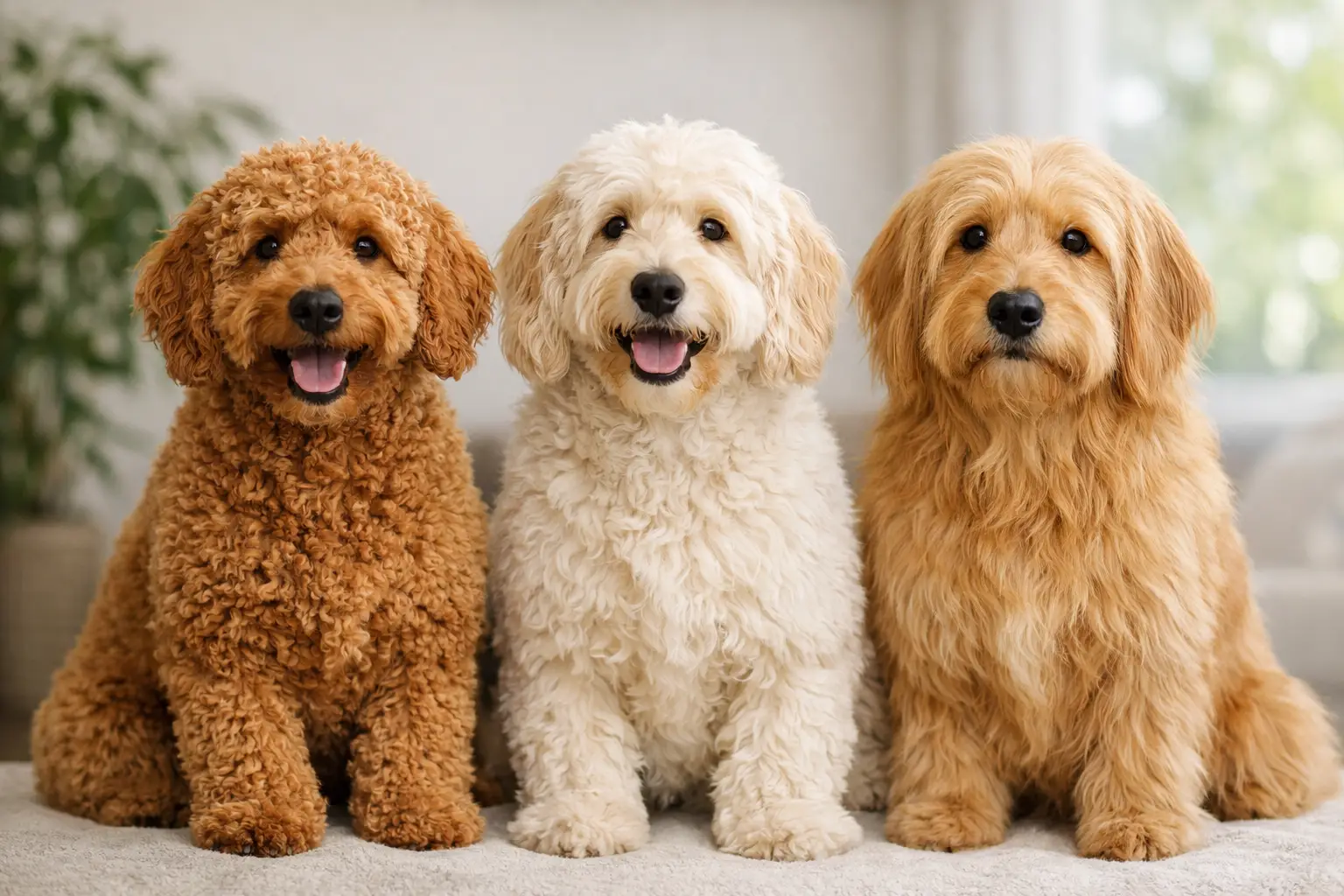
Most Goldendoodle coats fall into three general categories: straight, wavy, and curly. You may also hear people describe them as hair, fleece, or wool coats. Those terms can be helpful, but for most families, straight, wavy, and curly are easier to picture.
Straight coats
A straight coat is the least common look people expect when they picture a Goldendoodle, but it does happen. This coat tends to lie flatter against the body and often looks more like the Golden Retriever side.
Straight coats are usually the easiest to brush at home because they do not tangle as quickly as curlier coats. At the same time, they may shed more than wavy or curly coats. For some families, that trade-off is perfectly fine. If you want a lower-maintenance brushing routine and are not as concerned about a little extra hair around the house, a straighter coat may still be a lovely fit.
Wavy coats
Wavy coats are often the classic Goldendoodle look that many families fall in love with. They have that soft, shaggy, teddy bear appearance without being tightly curled.
This coat type is very popular because it often gives a nice middle ground. Wavy coats are commonly lower shedding than straight coats, but they are often a bit easier to maintain than very curly coats. That said, they still need consistent brushing. If a wavy coat is ignored, mats can build up faster than people expect, especially behind the ears, under the collar, under the legs, and around the tail.
Curly coats
Curly coats usually come through more strongly from the Poodle side. These coats can be soft and plush or more tightly curled, and they are often the most allergy-friendly option, though no dog is truly guaranteed to be completely hypoallergenic.
A curly coat is beautiful, but it does ask more of the owner. It typically needs very regular brushing and professional grooming to stay comfortable and healthy. The big advantage is that curlier coats are often lower shedding. The trade-off is maintenance. Families who love the curly look should go into puppy ownership expecting a routine, not just occasional grooming.
How generation can affect coat type
This is one of the questions I get often. Not every Goldendoodle generation is the same when it comes to coat consistency.
F1 Goldendoodles, which are a Golden Retriever and a Poodle, can have a wider range of coat outcomes. Some are straighter, some are wavy, and some are curlier. F1B Goldendoodles, which are produced by crossing an F1 Goldendoodle with a Poodle, often have curlier and lower-shedding coats.
That is one reason many families are drawn to F1B puppies. They often want a coat that leans more allergy-friendly and more predictably low shedding. Even then, every puppy is still an individual. A breeder should be honest about that. Genetics can guide expectations, but they do not create a perfect guarantee.
Shedding and allergy expectations
This is where I always encourage families to be realistic. A lot of people search for a dog that does not shed at all. In real life, most dogs shed at least a little, and Goldendoodles are no exception.
In general, straight coats tend to shed the most, wavy coats are often low shedding, and curly coats are usually the most minimal shedding. But there is a difference between low shedding and no maintenance. A low-shedding coat keeps more loose hair trapped in the coat instead of dropping it on your floor, which means that hair needs to be brushed out regularly.
For allergy concerns, curlier F1B coats are often a better choice for many families. Still, allergy sensitivity varies from person to person. If allergies are a major issue in your home, it is wise to spend time around similar dogs before making a decision.
What coat care really looks like at home
The most common mistake new doodle owners make is underestimating grooming. They see a fluffy puppy and think an occasional bath and quick brush will be enough. Usually, it is not.
A straight coat may need regular brushing but can be a little more forgiving. A wavy coat usually needs brushing several times a week. A curly coat often needs very consistent line brushing to prevent mats close to the skin. If mats are missed, they can become uncomfortable quickly and may require a short shave-down.
Bathing also matters, but bathing without proper brushing can actually make tangles tighter. Professional grooming every 6 to 8 weeks is common for many Goldendoodles, although some families keep a shorter trim and go more often for easier upkeep.
The good news is that coat care becomes much easier when it becomes part of your routine. A few minutes of brushing several times a week is usually much kinder to your dog than waiting until the coat is matted.
Choosing the right coat for your family
The best coat is not simply the one that photographs well. It is the one that fits your home.
If you want the soft doodle look with a balance of beauty and manageability, a wavy coat is often a wonderful fit. If minimizing shedding is your top priority and you do not mind regular grooming, a curly coat may be ideal. If you prefer easier brushing and do not mind that shedding may be somewhat higher, a straighter coat can still make a very sweet family companion.
I always encourage families to think about their real schedule. Are you comfortable brushing often? Will you stay on top of professional grooming? Do you have young kids and want a coat that is practical as well as adorable? These questions matter just as much as appearance.
Goldendoodle coat types guide for puppy buyers
If you are bringing home a puppy, remember that coats change as puppies grow. The soft puppy coat is not always the coat your dog will have as an adult. Around the time the adult coat starts coming in, many doodles go through a stage where matting increases. This is normal, but it means grooming becomes even more important.
Ask your breeder what they are seeing in the puppy’s coat texture, what the parents’ coats are like, and what kind of maintenance they expect. A good breeder should help you prepare honestly, not just tell you what sounds easiest.
At Shalom Goldendoodles by Mary, I want families to feel confident about every part of choosing a puppy, including the coat. A beautiful coat is a blessing, but a well-matched puppy is what really makes life sweeter in the long run.
If you are unsure which coat type is best for your family, that is completely normal. The right choice is usually the one that fits your daily life, your grooming commitment, and the kind of companion you want beside you for years to come.


[…] many families, coat and shedding are the first reasons to compare doodle generations. This is where an F1B Goldendoodle is often […]