

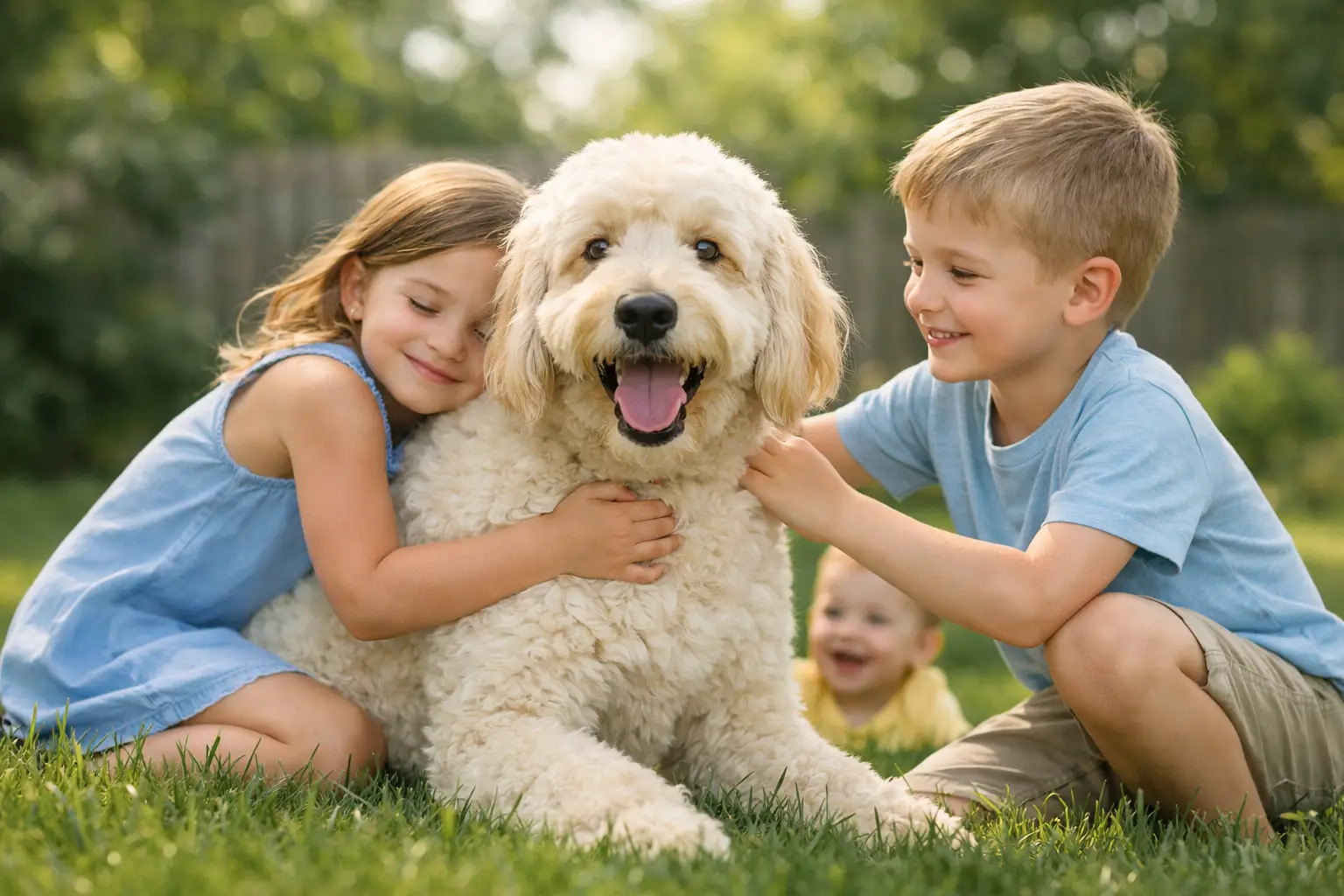
If you have little ones running through the house, you are probably not just asking whether a dog is cute or smart – you are asking whether that dog will truly fit into family life. When families ask me, are goldendoodles good with children, my honest answer is yes, they often are. But like any breed, the full answer depends on temperament, training, supervision, and how the puppy is raised from the very beginning.
That is why this question matters so much. A family dog is not just a pet in the corner of the room. This is the puppy who will sit beside your child during movie night, follow them into the backyard, and grow up right alongside your family. You want a dog that is loving and gentle, but also one that can handle the noise, movement, and energy that come with children.
Why Goldendoodles are often good with children
Goldendoodles are loved by so many families because they tend to combine some wonderful qualities. They are usually affectionate, intelligent, social, and eager to be part of what the family is doing. That desire to connect with people is one of the reasons they often do so well in homes with kids.
In my experience, Goldendoodles are not the kind of dogs who want to be left out. They enjoy companionship. They like being near their people, and that includes children. Many of them are playful without being overly intense, which can be a great match for family life.
Their intelligence helps too. Goldendoodles generally learn routines quickly, and children thrive on routines. A dog that can learn house rules, basic commands, and family patterns often settles into the home more smoothly. That does not mean they train themselves, of course, but it does mean they are usually very responsive when families put in the time.
Are Goldendoodles good with children of all ages?
This is where it helps to be realistic. Goldendoodles can be wonderful with children, but the age of the child makes a difference in how that relationship should be managed.
Toddlers and preschoolers
Young children are sweet, but they can also be loud, unpredictable, and a little rough without meaning to be. They may grab fur, lean on a puppy, or run and squeal in ways that excite the dog. Even a gentle Goldendoodle needs supervision around very young children.
A puppy is still learning. He may jump, nip during play, or get overstimulated. That does not make him a bad family dog. It just means he needs guidance, structure, and patient adults who are teaching both the puppy and the child how to interact kindly.
School-age children
This is often a lovely age for Goldendoodles and kids to bond. Older children can help with simple tasks, learn how to use calm commands, and understand when the puppy needs rest. They are more likely to respect boundaries and enjoy training games, backyard play, and snuggle time.
Many families find that once children are old enough to interact gently and consistently, the Goldendoodle really becomes part of their everyday rhythm.
Teenagers
Teens often do especially well with Goldendoodles because they can take a more active role in exercise, training, and daily care. Since Goldendoodles are social and energetic, that extra involvement can be a big benefit. A teen who wants a real companion may find a wonderful friend in a Goldendoodle.
Temperament matters more than hype
One thing I always want families to understand is that no breed should be treated like a guarantee. Goldendoodles have many traits that make them appealing for homes with children, but every puppy is still an individual.
Some puppies are naturally calm and cuddly. Others are more energetic and silly. Some are bold and confident right away, while others are softer and need a little more reassurance. Good breeding and early socialization make a difference, but personality still matters.
That is why I believe the beginning of a puppy’s life is so important. Puppies who are raised inside a home, handled daily, and exposed to normal family activity tend to have a better foundation for family life. They are not starting from scratch when they meet children, hear household sounds, or experience the busy pace of a real home.
What helps a Goldendoodle do well with kids
A family-friendly breed still needs a family-friendly environment. If you want the best relationship between your children and your puppy, a few things matter a lot.
Early socialization
Puppies need positive exposure to people, sounds, touch, and everyday life. A well-socialized Goldendoodle is more likely to grow into a confident and relaxed companion. This does not mean overwhelming the puppy. It means steady, gentle exposure that teaches him the world is safe.
Consistent training
A smart dog is a blessing, but smart dogs learn bad habits quickly too. Jumping, mouthing, and pulling on the leash are common puppy behaviors, and families need to address them early. The good news is that Goldendoodles are usually eager to please, which makes training a very worthwhile investment.
Simple commands like sit, down, come, leave it, and place can make everyday life with children much calmer and safer.
Adult supervision
This one never goes out of style. No matter how sweet the dog is or how kind the child is, adults should supervise interactions, especially in the early months. Supervision protects everyone and helps build trust.
Teaching children how to behave around dogs
Children need training too. I say that lovingly, because kids often have the biggest hearts. They just need help learning what a puppy enjoys and what feels scary or uncomfortable.
Children should know not to disturb a puppy while eating or sleeping, not to chase him, and not to hug too tightly. Gentle petting, calm voices, and respectful play create a much better bond.
The trade-offs families should know
I always prefer honesty over making a breed sound perfect. Goldendoodles can be amazing family companions, but they are not effortless.
They are often energetic, especially when young. If a family wants a dog that is content to lie quietly all day with very little exercise, a Goldendoodle may feel like a lot. They usually need walks, playtime, mental stimulation, and human interaction.
They can also go through mouthy puppy stages, just like many other breeds. With small children, that phase can feel frustrating if families are not prepared for it. The behavior is usually manageable with training and consistency, but it is still something to expect.
Size matters too. A Standard Goldendoodle may be loving and gentle, but a bigger puppy can accidentally knock over a toddler simply from excitement. That does not mean the dog is aggressive. It just means families need realistic expectations and good training.
Standard vs. smaller Goldendoodles for families
Some families wonder whether a smaller Goldendoodle is better for children. The answer depends on your household.
A Standard Goldendoodle can be a wonderful fit for active families who want a sturdy, playful companion. They often do well with kids who enjoy outdoor play and have enough space for a larger dog.
A smaller Goldendoodle may feel easier for some families, especially if you have limited space or want a dog that is easier to travel with and manage physically. Still, smaller dogs are not always the best choice for very young children if the child is clumsy or rough. Tiny dogs can be more easily injured.
So it is not as simple as saying bigger is better or smaller is better. It really comes down to your home, your children’s ages, and the kind of daily life you live.
So, are Goldendoodles good with children?
For many families, yes. Goldendoodles are often affectionate, social, trainable, and deeply connected to their people, which makes them a strong choice for homes with children. When they are well bred, well socialized, and guided with consistent training, they can become the kind of companion children remember for a lifetime.
At Shalom Goldendoodles by Mary, I have seen how beautiful that bond can be. A puppy raised with care and brought into a family that is ready to invest time, love, and structure often grows into a steady and cherished friend.
If you are considering a Goldendoodle for your family, I would encourage you to think beyond the breed name and look closely at temperament, early raising, and your family’s readiness. The right puppy in the right home can bring so much joy, comfort, and companionship – especially to children who are ready to love him well.