

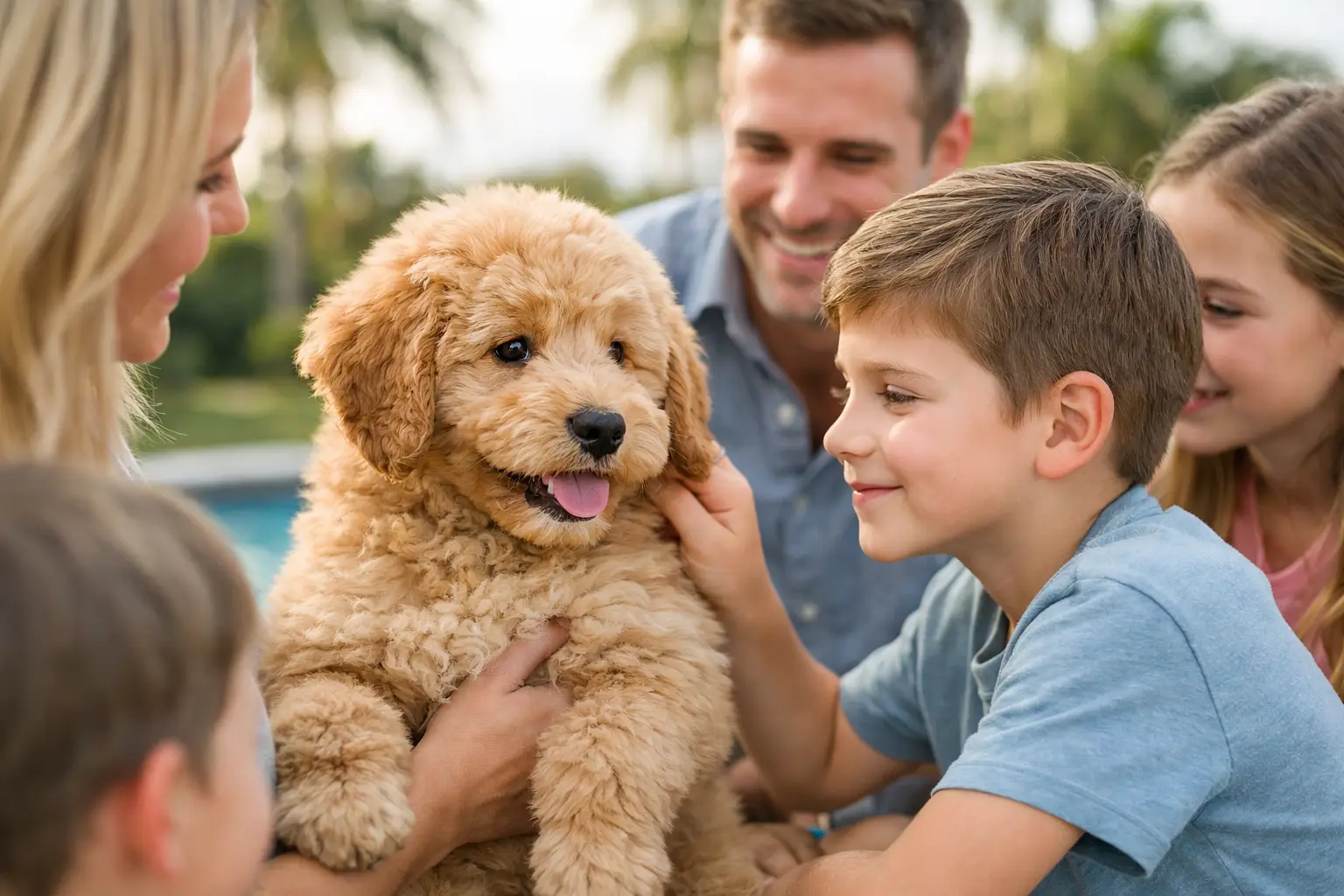
The happiest puppy placements are not about choosing the first sweet face you see in a photo. They are about finding the puppy whose personality, expected size, energy, and needs fit naturally into your family’s everyday life. This family puppy matching process example shows the kind of thoughtful conversation I have with families before a Goldendoodle goes home.
I raise my puppies inside my home, where I get to know them as little individuals from the beginning. Even puppies from the same litter can be wonderfully different. One may be ready to greet every new person, another may be content to watch for a moment before joining in, and another may be the first to carry a toy across the room. Those differences matter when a puppy is becoming someone’s beloved family member.
Why matching matters more than picking by color
Coat color, markings, and fluffy faces are part of the joy of choosing a puppy. I understand why families fall in love with a certain look. But appearance cannot tell us whether a puppy is likely to be comfortable with a busy household, enjoy quiet evenings with a couple, or thrive with a family that loves weekend adventures.
A good match considers the whole picture. I want to learn about the people in the home, children and other pets, work schedules, activity level, housing, past dog experience, and what the family hopes life with a dog will feel like. In return, I share what I have observed about each puppy while they are growing, playing, resting, and interacting with people.
This does not mean a puppy’s future is completely fixed at a few weeks old. Training, consistency, socialization, and love all shape a dog tremendously. Still, starting with a temperament that complements a family can make the transition smoother for everyone.
A family puppy matching process example
Imagine a family from Central Florida with two children, ages six and nine. Both parents work, but one parent works from home several days a week. They have a fenced yard, enjoy walks in the evening, and have never owned a Goldendoodle before. Their children are excited about a playful puppy, but the parents also want a companion who can settle near them during homework, family movie nights, and quiet time at home.
They initially contact me because they are drawn to a particular apricot-colored puppy. She is beautiful, and I can certainly understand the connection. Before confirming a choice, though, I would ask a few caring questions. Are the children comfortable following gentle puppy-handling rules? Will an adult manage feeding, potty trips, grooming, and training? Is the family prepared for the early mornings, chewing, accidents, and patience that come with any young puppy?
As we talk, I may learn that the family wants a standard Goldendoodle because they enjoy being outdoors and have room for a larger companion. An F1B Standard Goldendoodle may be a lovely fit, especially if they are prepared for an adult dog typically in the 50 to 70 pound range. If their schedule, living space, or travel plans point toward a smaller dog, I may also talk with them about whether an F1B Toy Goldendoodle better suits their household.
What I observe in the litter
By the time families are preparing to choose, I have spent many days with the puppies in a real home environment. I watch how each puppy responds to everyday sounds, human attention, gentle handling, toys, new spaces, and time away from littermates. I also notice how they recover after a brief surprise or excitement. A puppy who pauses and then comes back to investigate may have a different style than the puppy who rushes in immediately.
For this example family, I might see that the apricot puppy they first loved is especially lively, vocal, and determined to be at the center of every game. She could be a wonderful choice for an active, experienced home ready to channel plenty of enthusiasm into training and play.
But another puppy in the litter may be equally affectionate while showing a more balanced rhythm. Perhaps he happily joins playtime, seeks out people, and then settles comfortably when the activity slows down. He may enjoy being held, recover quickly from new experiences, and respond well when redirected. Based on what I have seen, I may recommend that puppy for this particular family.
That recommendation is never meant to take the joy or choice away from a family. It is simply my honest guidance from someone who has loved and cared for these puppies from their first days. My goal is not to place the most energetic puppy or the cutest color first. My goal is to help a family welcome the puppy who has the best chance to flourish with them.
The questions that help me make a thoughtful recommendation
A family does not need to have every answer perfectly prepared. First-time dog owners are welcome, and I am always happy to explain what puppy life really looks like. Honest answers help much more than “perfect” answers.
I usually want to know how much time the puppy will spend alone, who will be responsible for daily care, whether there are children or pets in the home, and what kind of activity the family enjoys. I also ask about grooming expectations. F1B Goldendoodles are often low-shedding to minimal-shedding, but low shedding does not mean no coat care. Curlier coats can require regular brushing and professional grooming to stay comfortable and free of mats.
I also encourage families to think about their hopes for companionship. Some want a walking buddy, some want a gentle emotional support companion, and some want a cheerful dog to grow up alongside their children. Many homes want all of those things. The details help me understand which puppy’s emerging temperament may be the most natural fit.
Matching is guidance, not a guarantee
A responsible puppy matching process should be personal, but it should also be honest. No breeder can promise that a puppy will never have a difficult day, dislike a particular sound, or grow into the exact personality imagined at eight weeks old. Puppies are living beings, not personality test results.
The family’s role after bringing a puppy home is just as meaningful. Positive training, safe socialization, a predictable routine, appropriate exercise, veterinary care, and kind boundaries all help a puppy grow into a confident adult dog. A gentle puppy still needs guidance. A bold puppy still needs calm leadership and opportunities to learn manners.
There are trade-offs, too. A puppy with a lively, outgoing nature may bring extra fun and confidence to a busy household, but may need more intentional training around jumping, excitement, and settling. A softer, more observant puppy may be deeply affectionate and easier going in some situations, but may benefit from a slower introduction to new people and places. Neither type is better. The right fit depends on the home.
Preparing for the match before puppy pickup
Once a family and I feel good about the match, I encourage them to prepare for the puppy they are welcoming, not just the puppy they imagined. Set up a safe sleeping space, choose a consistent potty area, make a plan for meals and daytime breaks, and talk with children about calm, gentle interactions. A puppy needs rest just as much as play, especially during the first exciting days at home.
For the example family, this could mean the parents agree that adults will handle the early training routine, while the children help with age-appropriate jobs such as filling a water bowl with supervision or practicing a gentle sit cue. The family may schedule short walks, quiet bonding time, and regular brushing from the start. These simple routines help the puppy feel secure.
At Shalom Goldendoodles, I want every family to feel supported as they make this meaningful decision. The right puppy is not necessarily the loudest, smallest, fluffiest, or first one to catch your eye. Often, it is the puppy whose needs and personality make room for a beautiful relationship in the life you already share.
When a family approaches the process with open communication, realistic expectations, and a willing heart, the puppy match becomes the beginning of something much bigger: years of companionship, laughter, learning, and love.