
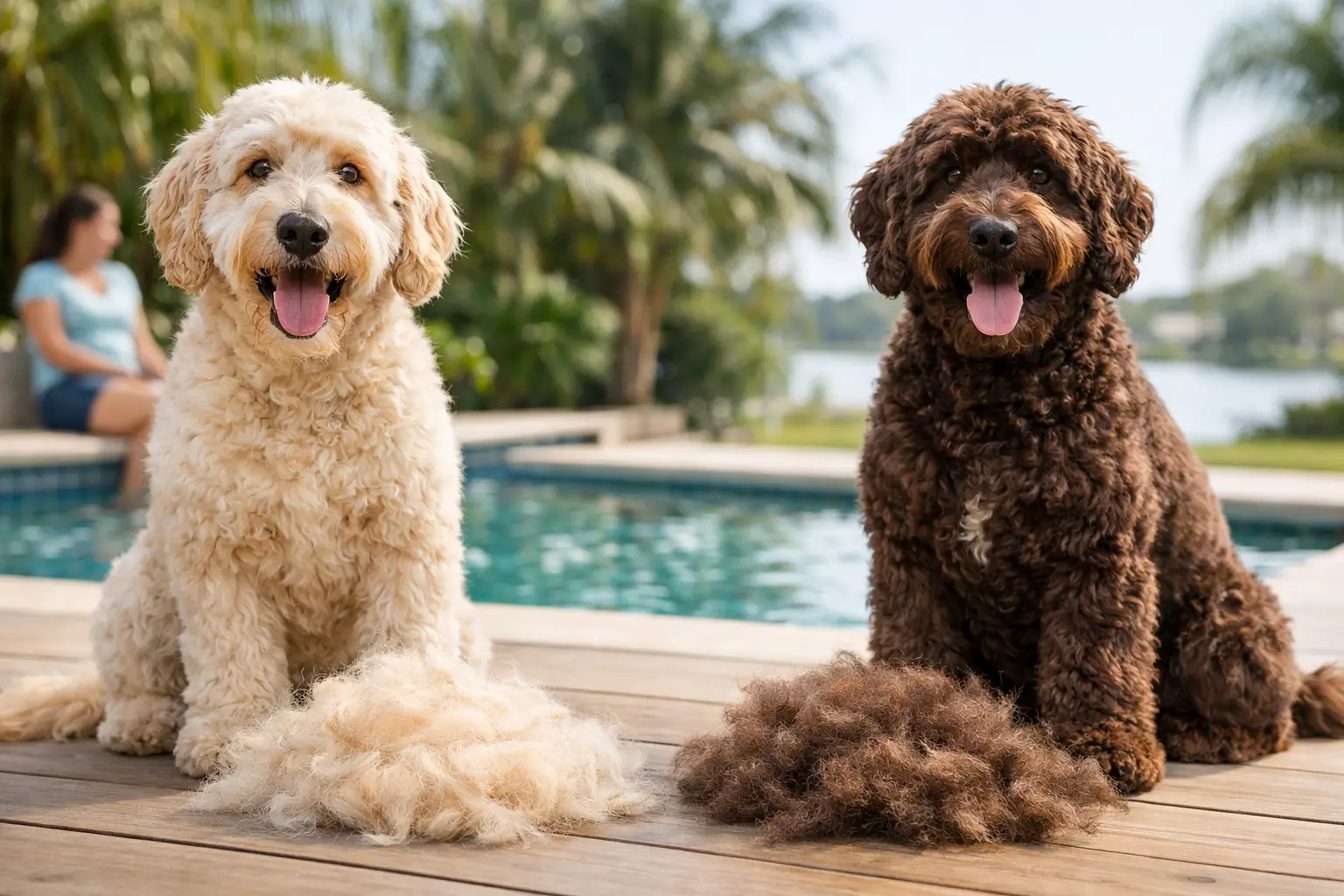
A light-colored dog hair on the sofa is one thing. Tufts collecting along the baseboards every day are another. When families ask me about Goldendoodle versus Labradoodle shedding, I always start with the honest answer: either breed can be lower shedding, but neither comes with a guaranteed, completely hair-free home.
The puppy’s individual coat, genetics, and generation matter more than the word “doodle” on its own. A well-matched puppy can make a wonderful companion for a family that prefers less loose hair around the house, but it also comes with a grooming commitment. Understanding that trade-off before bringing home a puppy helps everyone start off happy.
Goldendoodle Versus Labradoodle Shedding: The Short Answer
Goldendoodles and Labradoodles are both crosses between a Poodle and a retriever breed. Goldendoodles have Golden Retriever heritage, while Labradoodles have Labrador Retriever heritage. Since Poodles tend to shed very little, both mixes may inherit a lower-shedding coat. But Golden Retrievers and Labrador Retrievers are both shedding breeds, so the retriever side of the family still matters.
In general, a curlier, more Poodle-like coat is more likely to release less hair into your home. A straighter or wavier coat with more retriever influence is more likely to shed noticeably. That is true for both Goldendoodles and Labradoodles.
If two puppies have comparable Poodle influence and similar curly coats, their shedding levels may be very close. It would not be fair to promise that one breed always sheds less than the other. Families sometimes hear that Goldendoodles are automatically the lower-shedding choice, but a puppy’s particular coat and breeding background are far more meaningful than the breed label alone.
Coat Type Matters More Than Color or Cuteness
Most doodle coats fall somewhere along a spectrum: straight or flat, wavy or fleece-like, and curly or wool-like. Each puppy is an individual, even within the same litter.
A straight or lightly wavy coat can be beautiful and soft, but it may carry more of the shedding pattern from the Golden Retriever or Labrador parent. These dogs may leave more hair on clothing, furniture, and car seats, especially during seasonal coat changes.
A wavy coat is often a middle ground. Many families love this teddy-bear look, and some wavy-coated dogs shed lightly. Still, wavy does not always mean low shedding. A loose wave with a soft undercoat may shed more than a tighter wave with strong Poodle influence.
Curly coats are commonly the best fit for families hoping for minimal visible shedding. Loose hairs tend to stay caught in the curls instead of falling around the house. That sounds ideal, but those trapped hairs need to be brushed out. Without regular brushing, they can form mats close to the skin.
This is why I encourage families not to choose a puppy based on coat color alone. Apricot, cream, red, chocolate, black, and parti coats can all shed at different levels. The texture and genetics behind the coat tell us much more.
Why Generation Changes the Conversation
A doodle generation describes the breeding behind a puppy. It does not predict every detail of personality, health, or coat, but it gives families helpful context about the likelihood of Poodle traits.
An F1 Goldendoodle or Labradoodle has one purebred retriever parent and one purebred Poodle parent. Because the genetic mix is more evenly divided, F1 puppies can have a wider range of coats and shedding levels. Some will have a low-shedding, wavy or curly coat, while others may inherit a looser coat that sheds more.
An F1B doodle is produced by breeding an F1 doodle back to a Poodle. This usually increases the likelihood of a curlier, lower-shedding coat, though it is still not a promise. At Shalom Goldendoodles, I specialize in F1B Goldendoodles because many families appreciate their affectionate, intelligent nature and the greater likelihood of low-shedding coats.
Multigenerational doodles can also be bred with low shedding in mind. However, responsible breeding is about much more than coat type. Temperament, health testing, structure, and thoughtful pairing of parent dogs should always be part of the picture.
Low Shedding Does Not Mean No Grooming
This is the part I want families to understand clearly before they bring home a doodle. Less shedding often means more coat care. The hair that would otherwise fall to the floor can remain in a curly or wavy coat, where it can tangle with loose hair, dirt, and moisture.
Most Goldendoodles and Labradoodles benefit from thorough brushing several times a week. A curlier coat may need brief attention every day, especially around the ears, collar area, under the legs, tail, and belly. Those are the places where mats like to hide.
Professional grooming is usually needed on a regular schedule as well, often every six to eight weeks depending on coat length, activity level, and the family’s home routine. Florida families may prefer a shorter trim during warm weather, while others enjoy keeping a fluffier look and are ready to brush more often.
A low-shedding doodle is not a low-care dog. For the right family, grooming can become a sweet part of bonding. For a busy household that does not enjoy brushing or scheduling grooming appointments, a coat that sheds a little more may actually be easier to maintain.
What About Allergies?
No dog is truly hypoallergenic. People with allergies can react to dander, saliva, and urine proteins, not just loose fur. Since lower-shedding dogs may spread less hair and dander through the home, some allergy-sensitive families find them easier to live with. Others still have symptoms.
If someone in your household has significant allergies or asthma, spend time around adult dogs with similar coats before making a commitment. If possible, meet the puppy’s parents too. This gives your family a more realistic sense of how you may respond than any breed description can provide.
Frequent bathing with appropriate products, clean bedding, a good home cleaning routine, and regular grooming can also reduce allergens. Still, allergies should be approached thoughtfully and honestly. A puppy deserves a forever home where every family member can be comfortable.
How to Choose the Right Doodle for Your Home
Rather than asking only, “Which one sheds less?” I encourage families to think about the kind of daily life they can offer a dog. A Goldendoodle may be a lovely fit for someone drawn to the Golden Retriever’s gentle, people-loving nature. A Labradoodle may appeal to a family that loves the Labrador’s outgoing, playful personality. Individual temperament and the care a puppy receives from the beginning matter greatly in both breeds.
Ask a breeder about the parents’ coat types, the puppy’s generation, and what they have seen in previous litters. A trustworthy breeder should be willing to talk plainly about what is likely, what cannot be guaranteed, and the grooming that will be required. Be cautious of anyone who promises a completely nonshedding or allergy-proof puppy.
It also helps to be flexible. A family may come in hoping for the lowest-shedding, tightest-curled puppy, then meet a confident, affectionate puppy with a soft wavy coat who feels like the perfect match. Coat needs matter, but a lifelong companion is more than a coat.
The best choice is a puppy whose expected shedding level and grooming needs fit comfortably into your family’s routine. When that practical piece is in place, you have more room to enjoy the wonderful moments that matter most: muddy paw prints after playtime, a warm head in your lap, and the happy welcome waiting for you at the end of the day.