

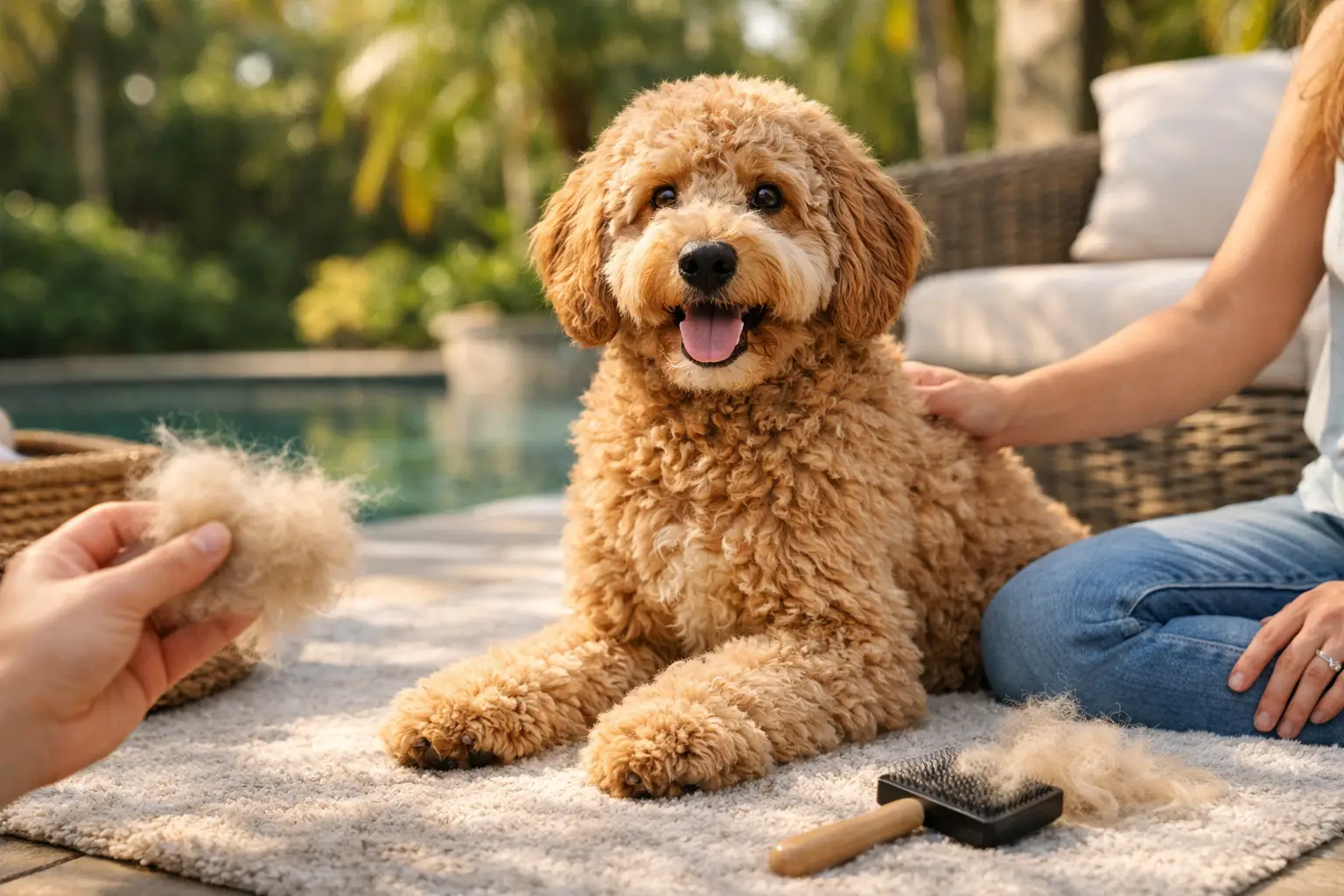
A fluffy puppy may look like a walking cloud, but families often have a very practical question before bringing one home: Are F1B Goldendoodles low shedding? In most cases, yes. F1B Goldendoodles are commonly low shedding to minimal shedding, especially compared with many other dogs. Still, I always want families to understand that low shedding does not mean no shedding, no grooming, or a guaranteed fit for every person with allergies.
At Shalom Goldendoodles, I believe honest expectations are one of the best ways to help a puppy and family begin well together. A Goldendoodle should be loved for much more than a coat type, but understanding that coat will help you choose wisely and care for your puppy confidently.
Why F1B Goldendoodles Tend to Shed Less
An F1B Goldendoodle is bred by crossing an F1 Goldendoodle with a Poodle. An F1 Goldendoodle has one Golden Retriever parent and one Poodle parent. Because an F1B puppy has a Poodle parent and an F1 Goldendoodle parent, the puppies are, on average, more Poodle-rich genetically.
That additional Poodle influence often brings a curlier or wavier coat that holds onto loose hair rather than dropping it around the house. This is why many families see far less hair on furniture, clothing, floors, and car seats with an F1B Goldendoodle than they might with a Golden Retriever or another more heavily shedding breed.
For busy homes with children, that can make a real difference. Families still need to brush, bathe, and schedule professional grooming, but they are often not constantly sweeping up clumps of dog hair.
Are F1B Goldendoodles Low Shedding in Every Case?
No responsible breeder can promise that every puppy will have the exact same coat or shed at precisely the same level. Genetics are wonderfully complex. Even puppies from the same litter can have coats that differ in curl, thickness, texture, and shedding tendency.
Most F1B Goldendoodles fall into the low-shedding or minimal-shedding range, but an individual puppy may shed a little more or a little less. A puppy with a tighter, curlier coat often sheds less visibly. A puppy with a loose wavy coat may release somewhat more hair, though usually still less than a typical Golden Retriever.
Age can also affect what families notice. Puppies have soft puppy coats, and their adult coats begin coming in as they grow. During that transition, their texture can change quite a bit. Your puppy may become curlier, fuller, or easier or harder to maintain than he or she seemed at eight weeks old.
Health, nutrition, skin conditions, stress, and seasonal changes can influence shedding as well. Sudden or excessive hair loss is not something to simply assume is normal. It is worth discussing with your veterinarian, especially if you also notice itching, flaky skin, redness, or changes in your dog’s behavior.
Low Shedding Does Not Mean Hypoallergenic
I often hear the terms low shedding and hypoallergenic used as if they mean the same thing. They are related, but they are not identical.
Dog allergies are usually triggered by proteins found in dander, saliva, and urine, not just the hair a dog sheds. Since low-shedding coats may spread less loose hair and dander through the home, some people with mild allergies find F1B Goldendoodles easier to live with. But no dog is completely allergy-free, including a Poodle or a Goldendoodle.
If someone in your home has allergies, I encourage you to spend time around adult Goldendoodles or similar-coated dogs before making a commitment. Pay attention to how that person feels after meaningful contact, not just a quick visit. For families with severe allergies or asthma, it is especially wise to talk with an allergist before bringing any dog home.
A puppy is a family member for many years, so it is better to move carefully than to rely on a label that cannot make a medical guarantee.
The Trade-Off: Less Shedding, More Coat Care
A low-shedding coat is often a wonderful fit for family life, but it comes with a responsibility. Hair that does not fall out freely can tangle with loose hair, dirt, moisture, and everyday debris. Without regular brushing, mats can form close to the skin.
Mats are more than a cosmetic concern. They can pull on the skin and make a dog uncomfortable. In severe cases, grooming may need to be very short to safely remove them. That is why I encourage families to plan for grooming before their puppy comes home, rather than waiting until the coat becomes difficult to manage.
For many F1B Goldendoodles, a thorough brushing several times a week is a good starting point. Puppies who have a curlier coat, love water, wear harnesses often, or spend lots of time outdoors may need more frequent attention. Areas behind the ears, under the collar, under the legs, around the tail, and where the harness rests deserve extra care because mats often begin there.
Professional grooming is usually needed every six to eight weeks, depending on the coat length and your preferred style. A shorter teddy-bear trim can be easier for active families to maintain, particularly in Florida’s heat and humidity. A longer fluffy coat is beautiful, but it requires more consistent brushing at home.
What Coat Types Can You Expect?
F1B Goldendoodles commonly have curly, wavy, or sometimes straighter fleece-like coats. Curlier coats often resemble the Poodle side more strongly and are generally associated with lower visible shedding. Wavy coats can have the soft, tousled Goldendoodle look many families love, while still being low shedding.
Color and coat texture are separate considerations. A puppy’s coat may be apricot, red, cream, chocolate, black, or another beautiful shade, but color alone does not tell us how much the puppy will shed. It is much more helpful to look at the puppy’s individual coat, the parents’ coats, and the breeder’s knowledge of the line.
When I talk with families, I encourage them to think beyond a specific look. A family with young children, a first-time dog owner, or a household with a packed schedule may be happiest with a coat that is easier for them to maintain. The best puppy is not simply the fluffiest one. It is the puppy whose needs fit naturally into your family’s life.
Keeping Your Home and Puppy Comfortable
Good coat care starts with simple habits. Begin gentle brushing while your Goldendoodle is young, even when the coat does not appear to need it. Offer calm praise and small treats so grooming becomes a normal, positive part of life. This early practice can make future appointments and at-home care much easier.
Use a quality slicker brush and a metal comb, working in small sections down to the skin rather than brushing only the top layer. If the comb glides through easily, you are usually doing a good job. If you find tangles, address them gently before they become tight mats.
Bathing too frequently can dry the skin and coat, so use a gentle dog shampoo when your puppy truly needs a bath. Regular nail trims, ear checks, and dental care are also part of keeping a Goldendoodle comfortable and healthy. A well-maintained coat supports more than a tidy home. It helps your dog feel good.
Is an F1B Goldendoodle Right for Your Family?
An F1B Goldendoodle can be a wonderful choice for families who want an affectionate, intelligent companion with a low-shedding to minimal-shedding coat. They are often eager to learn, social, and deeply connected to their people. They also need companionship, training, exercise, and regular grooming.
If you want a dog that requires no brushing and no upkeep, an F1B Goldendoodle may not be the right match. If you are ready to make grooming part of your routine, though, the trade-off can be well worth it. You may have less hair around the house and a loving, joyful companion beside you for daily life.
My hope is always that each family chooses with both their heart and their practical needs in mind. The right puppy will bring plenty of happy moments, and a little time with a brush can become another quiet way of caring for the dog who has become part of your family.